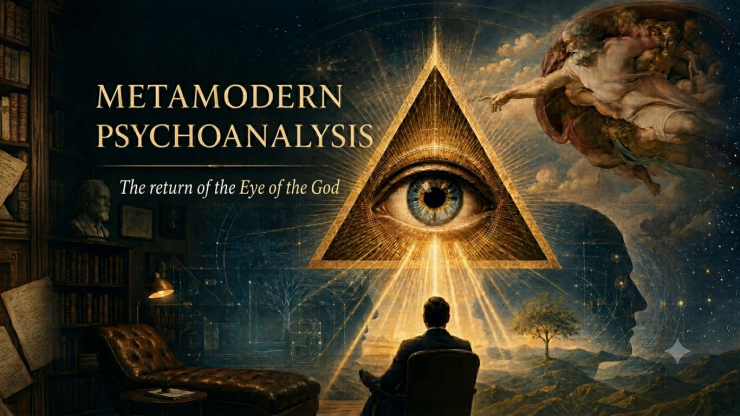
Metamodern Psychoanalysis – The Return of the Eye of God
Vladimir Nemet
1. Introduction: The Evolution of Human Suffering Through the History of the Soul
Human suffering never arises in a vacuum. It is born in an intense dialogue between the human being and the spirit of the epoch in which they live. Every era carries its own prohibitions, its own ideals, and its own ways of allowing — or forbidding — a person to be what they are.
Throughout history, human beings have attempted to establish a balance between two fundamental poles of subjectivity. On one side stands the Big I — the sense of uniqueness, power, and personal significance; everything the ancient Greeks called thymos, the inner experience of being the center of a world to which everything belongs.
On the other side stands the Big You — everything that transcends and simultaneously grounds us. It is the instance that defines, designates, and constitutes us; our great observer and our supreme meta-signifier.
Experience shows that what is most difficult for the human psyche is allowing these two peaks to coexist. Therefore, every civilization, religion, and psychology, in its own way, attempts to strengthen one while suppressing the other. Sometimes the Big I is permitted while the Big You is suspended; sometimes the opposite occurs. To contain both simultaneously within the self is a paradox the psyche struggles to endure. Thus, human history can be read as a continuous dramatic oscillation between these two extremes.
The deepest human drama, then, is perhaps not the eternal struggle between good and evil, but the tragic impossibility of allowing both the Big I and the Big You to fully exist at the same time.
In this lecture, we follow the story of Mark, a 28-year-old IT specialist suffering from a panic fear of other people’s gaze. He believes others observe, evaluate, and gossip about him behind his back. He becomes speechless in front of women, and in meetings he feels constantly watched, while simultaneously doubting that anyone truly sees him at all. Mark will be our traveler through time.
We begin in the premodern age, which sees the solution in renunciation of personal power and submission to a higher order. Salvation is found in restraining and controlling the Big I so that it may again enter the horizon of the Eye of God.
We then move into the modern age, a radical break from the premodern. Here, the Big I is strengthened, while the Big You loses its tyrannical power. Freud’s psychoanalysis continues this movement by attempting to dismantle the dominance of the Big You. The Eye of God is no longer outside the subject; it is relocated inward, into the psychological structure known as the Superego.
After that comes the postmodern age, which becomes suspicious of both the Big I and the Big You. Both are now seen as social constructions, products of discourse and meta-narratives that must be deconstructed.
Finally, we arrive at the metamodern turn. Here, something entirely new happens. For the first time, we do not sacrifice one pole to save the other. The Big I is no longer a sin, and the Big You is no longer a tyrant. Both are granted the right to exist. It is as if two parallel universes of human experience finally meet at a single point — as parallel identities that coexist.
Where the Big I and the Big You meet, a space of the human soul opens.
Let us therefore begin a journey through the history of the human soul — a history of its prohibitions, its illusions, its rebellions, and its eternal longing for Otherness.
2. Clinical Case: Mark, 28 Years Old
Mark is 28 years old and works as an IT specialist in a large company. At first glance, he appears quiet, polite, and responsible. He performs his tasks reliably but avoids meetings, public presentations, and informal social interactions with colleagues.
His greatest difficulty is contact with other people, especially women. When he finds himself near a woman he likes, he is overwhelmed by intense discomfort. His heart races, his palms sweat, and his voice becomes uncertain. The central question arises: “What if she notices how nervous I am? She must see that something is wrong with me.” Due to this unbearable inner pressure, Mark often withdraws before a conversation even begins.
Similar difficulties appear in everyday situations. When entering a café, he feels that all eyes are directed at him. If he passes two people laughing, he automatically assumes they are laughing at him and gossiping behind his back. In these moments, he is convinced that others see his weaknesses, notice his insecurity, and consider him strange. Although he rationally knows there is no evidence for these conclusions, the feeling remains completely real.
Over the years, his life has significantly narrowed. He refuses career advancement due to public speaking requirements, has no romantic relationship, and spends most evenings alone in his apartment. He increasingly feels lonely, yet simultaneously believes that others would reject him immediately if they truly got to know him.
He has undergone several psychotherapies without major success. He remains preoccupied with questions such as: Am I successful enough? Am I rich enough? Am I man enough? What do people really think of me?
3. The Premodern Perspective – The Big You
How would the premodern world understand Mark’s problem?
The premodern era spans the long historical period from the emergence of early civilizations and writing systems to the Enlightenment, the philosophy of Francis Bacon and René Descartes, and the industrial revolutions of the late 19th century.
Despite vast cultural differences, the premodern world is united by one fundamental idea: the human being is never the center of the world. The center always belongs to the Big You.
From this perspective, Mark’s condition is not seen as a psychological disorder. His anxiety, fear of people, and panic attacks are interpreted as signs of a broken relationship with what transcends him — a “dark night of the soul,” or more precisely, the result of excessive self-preoccupation in which the Self becomes too large and too loud, blocking the view of the divine. In this sense, his suffering is a sign of spiritual disharmony, even of pride — a grave sin.
In other words: his Big I separates him from the Big You.
Therefore, the goal of “therapy” in the premodern framework is not the strengthening of identity, but its reduction, restraint, and purification. The Big I must be tamed so that it can once again become permeable to the presence of the divine. Premodern cultures develop a wide range of practices toward this aim: fasting, prolonged abstinence, vigil, prayer, penance, confession, exorcism, and various ascetic disciplines. Despite their diversity, their inner logic is the same — to weaken the autonomy of the ego so that space opens for something greater.
The ultimate aim is mystical union with the Absolute: a moment in which the boundaries of the individual Self dissolve, and the subject enters the Big You — entering the horizon of the Eye of God.
The premodern human being does not ask: “Who am I?”
They ask: “How can I be in relation with That which is greater than me and contains me?”
The premodern soul does not seek salvation within itself. It seeks it in unity with something infinitely greater.
4. Modernity
Modernity emerges as a radical tectonic shift from the premodern world. In earlier centuries, the central psychic problem was human pride — the inflated Big I refusing to submit to Law. Modernity reverses this entirely. Now the source of suffering is the pressure and tyranny of the Big You.
The modern subject no longer suffers because it cannot merge with the divine, but because authority, tradition, and rigid social morality suppress its autonomy, authenticity, and freedom.
It is at this historical and psychological turning point that Freud’s psychoanalysis emerges, naming this oppressive internal Big You the Superego.
From the modern perspective, Mark’s problem takes on a new dynamic:
His fear that people on the street gossip about him, laugh behind his back, and think badly of him is actually a projection of his inner world. His Big You — his Superego — has become so strict, sadistic, and unforgiving that Mark projects it onto the external world. From there, it continuously watches, judges, and persecutes him. Mark is constantly standing in the dock of his own mental courtroom.
Therefore, modern psychotherapy radically changes the direction of “treatment.” Instead of premodern techniques of fasting, penance, and ego-dissolution aimed at diminishing the individual before the absolute, modern analytic practice does the opposite. Through techniques such as free association, analysis of resistance, dream interpretation, and transference analysis, it seeks to analyze, deconstruct, and reduce the destructive influence of the Big You — the Superego.
The goal is no longer mystical submission to authority, but emancipation.
The modern therapist does not ask Mark for obedience, but helps him silence the voice of the inner tyrant so that his own Big I can finally breathe. From this perspective, Mark may liberate his libido and become a “real man,” if that is what he seeks.
In short, if the premodern soul sought salvation in the Big You, the modern soul seeks salvation in freedom from the Big You — freedom from the judgmental gaze of the Eye of God.
But is this possible? Can a human being ever fully escape the need for authority? The modern subject no longer stands before God — it now stands before a gaze that follows it everywhere. This is no longer a sacred presence; it is an internal judge.
5. How Postmodernism Deconstructs Mark’s Identities
The postmodern era arrives as a third, more radical step in the evolution of human suffering. It takes no side in the historical conflict between internal and external authority. In Mark’s case, both the Big I and the Big You are revealed as illusions — rigid imposed structures that imprison him. They are meta-narratives that postmodern thought seeks to deconstruct.
From this perspective, Mark suffers because he has believed in fixed stories about himself and the world around him.
His Big You — the internal judge he believes constantly watches, gossips, and mocks him — is actually a social construct. It is an internalized Panopticon, a cultural narrative of what a successful 28-year-old man should be, look like, and achieve. Why should he even be successful or wealthy? And masculinity itself does not exist, since gender is performative, as Judith Butler argues.
Postmodern therapy does not try to repair Mark’s “I” nor reconcile it with the “You.”
Its goal is to dismantle all grand narratives, to strip them down and show Mark that both his self and his persecutors are linguistic constructions — social agreements and discourses. The therapist helps him understand that there is no fixed truth about “who he really is,” because human identity is fluid, multiple, and continuously rewritten. Mark can be whatever he wants.
If the premodern soul sought salvation in unity with the Big You, and the modern soul in liberation from it, the postmodern soul realizes that both “I” and “You” are just text.
However, this liberating deconstruction also hides a darker side — what could be called ontological hunger.
When Mark successfully deconstructs his Big I and Big You, he is freed from pressure and anxiety. Yet, with the disappearance of these structures, he is left facing an emptiness. If there is no Big You that observes him, and no fixed Big I being observed, then who is he?
Mark is now free, but hungry. He floats in a world without grounding, waiting for a paradigmatic response that only metamodernism can offer.
6. The Metamodern Turn – The Return of the Eye of God
After postmodern deconstruction leaves Mark alone on an empty stage — freed from old authorities yet exposed to ontological hunger and silence — metamodernism opens a new horizon. An unexpected reversal occurs.
The Big You returns. The meta-signifier returns. What ancient traditions called the Eye of God returns — a gaze that sees, knows, and contains.
But this is no longer the premodern God demanding submission or punishing transgression. The metamodern Mark has passed through modern rebellion and postmodern doubt. He has learned that human interpretations are fragile, ideologies incomplete, and knowledge partial. Therefore, his return to the Big You is not naïve, but mature.
In the metamodern therapeutic space, Mark gradually discovers that he does not seek freedom from the gaze, but the right gaze. He does not seek the absence of the observer, but an observer who can contain him without humiliation and without judgment.
When he finds this inner guiding star, the opinions of passersby lose their power. Criticism no longer penetrates the core of his being. His gaze rises above transient judgments toward a stable horizon.
He no longer asks: “Who am I in the eyes of others?”
He begins to feel: “I am already seen.”
Only when a human being finds a gaze that does not pass does he become free from all passing gazes.
The gaze of the premodern priest, shaman, or guru was an empty gaze — a servant of God without individuality. The gaze of the modern Freudian analyst is also neutral and empty — a servant of Science. The gaze of the postmodern thinker fears both the other’s power and their own. In contrast, the gaze of the metamodern analyst is not afraid to be everything and to hold everything. Only such a gaze heals.
But the metamodern turn does not end there. The blessing of the Big You awakens the Big I. If the premodern suppressed grandiosity and modernity disciplined it, metamodernism recognizes that the feeling of greatness is just as fundamental as the need for Otherness. Deep within human experience lies an ancient, almost cosmic sense that we are the center of the world, that life belongs to us, and that we are called to occupy our rightful place. Heinz Kohut called this cosmic narcissism in its positive form.
Mark has spent his entire life fleeing this feeling. He experienced his grandiosity as danger, arrogance, or madness. He repressed it in order to remain acceptable. But what he repressed was not only pride, but also vitality. Only now, in dialogue with the Big You, does his Big I gain the right to exist. The meta-signifier grants him permission to be large, to take space, to reach out — to experience the world as something that has always, in a sense, belonged to him.
And here the paradox emerges. The more he relies on the Big You, the less he needs to diminish himself. The more he accepts Otherness, the more freely he can be himself.
The Big You and the Big I are no longer enemies. They become two poles of the same ontological whole.
The human being becomes whole only when they can simultaneously feel: I am perfect and You are perfect.
7. Conclusion: Toward a New Wholeness of the Self
Mark’s journey from premodern to metamodern paradigms shows that clinical symptoms are not merely isolated disturbances within an individual psyche. What we call social phobia, panic attacks, or withdrawal from the Other is often the point where entire historical epochs intersect — as if through one fragile self, humanity repeatedly asks the same question: how can one encounter the Other without losing oneself?
The premodern world offered solidity and shelter under the Eye of God, but at the cost of suppressing individuality. Modernity brought emancipation from internal tyranny, but exposed the subject to new anxiety — the endless internal courtroom of self-judgment. Postmodernity dismantled both authority and subject, but this radical freedom gradually turned into emptiness.
At this point of emptiness, the metamodern turn appears. It opens the possibility of a mature tension between freedom and meaning, between finitude and infinity, between the Big I and the Big You. These are parallel identities.
In this encounter, they are no longer enemies but two modes of the same self unfolding toward the world. Only in their mutual recognition does Mark cease to be a fragmented subject torn between the gaze of others and his own inner insecurity. He becomes a self capable of enduring the gaze that transcends him, without losing his own significance.
The goal is a new form of wholeness — one that does not erase tension, but sustains it; one that does not eliminate paradox, but integrates it as the very structure of human existence.
Our task as analysts, therapists, and thinkers of this time is not to return the human being to lost forms of security, but to accompany them in their capacity to endure the presence of the Other without collapse or defense. To help them re-establish a vertical axis of meaning, not as a restrictive dogma, but as a space that holds them.
Human wholeness does not arise from removing the tension between the I and the Other, but from their capacity to remain simultaneously present.
Selected Literature:
Derrida, J. (1976). Of grammatology (G. C. Spivak, Trans.). Johns Hopkins University Press. (Original work published 1967)
Foucault, M. (1977). Discipline and punish: The birth of the prison (A. Sheridan, Trans.). Pantheon Books. (Original work published 1975)
Freud, S. (1961). The ego and the id (J. Strachey, Trans.). W. W. Norton & Company. (Original work published 1923)
Kohut, H. (1977). The restoration of the self. International Universities Press.
Lyotard, J.-F. (1984). The postmodern condition: A report on knowledge (G. Bennington & B. Massumi, Trans.). University of Minnesota Press. (Original work published 1979)