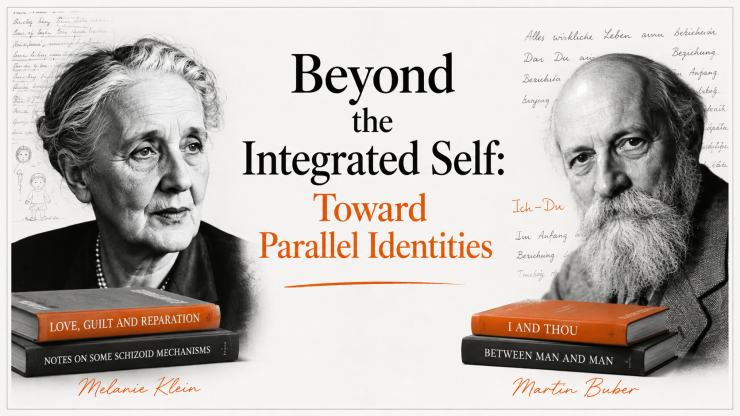
Beyond the Integrated Self: Toward Parallel Identities
Vladimir Nemet
1. Introduction: The Illusion of a Single Center
The history of psychoanalysis can be understood as a long search for a fundamental principle from which human personality might be derived. Freud located this principle in the drive, Klein in the object, Winnicott in transitional experience, Lacan in the signifier, Kohut in the cohesive self, Stolorow in the intersubjective field, Ogden in the analytic third, and Heidegger, at the ontological level, in Being.
Despite their profound differences, these approaches share a common assumption: that somewhere beneath the complexity of psychological life, there is a fundamental center from which experience is organized.
The Theory of Parallel Identities abandons this assumption. In short, the personality has no single underlying center.
Human experience is structured from the beginning by two irreducible poles: the I and the Thou. They cannot be reduced to one another, nor can they be integrated into a higher unity that would transcend their difference.
There is no third identity between I and Thou. There is only movement between them.
Personality is therefore neither the I, nor the Thou, nor an integrated synthesis of the two. It is the temporal organization of their continuous alternation.
Personality has no hidden center behind the I and the Thou; it comes into existence in the movement between them.
2. Freud: Otherness Is Not a Later Discovery
Classical psychoanalysis tends to imagine development as a movement from an initially self-contained state toward the discovery of the Other. Freud’s concepts of primary narcissism and the oceanic feeling are exemplary of this tendency.
But what if Otherness is not something discovered later?
The infant does not begin in isolation and subsequently enter into relationship. From the very beginning, human existence unfolds within a tension between I and Thou. The Other is not an addition to an originally complete self; the relation to the Other is constitutive of the emergence of the I itself.
I and Thou are therefore not fragments of some primordial One. Their difference is primary.
Development is not the movement from unity to differentiation. It is the gradual capacity to sustain a differentiation that was there from the beginning.
This changes the fundamental question of psychoanalysis. Instead of asking how the isolated self discovers the Other, we must ask how the human being learns to inhabit the tension between two centers of experience without reducing either of them to the other.
The Other is not discovered after the self is born; the self is born within the presence of the Other.
3. Winnicott: Transitional Space as the Space of Alternation
Winnicott’s concept of transitional space moved psychoanalysis decisively toward relationality. Yet the location of this space can be reconsidered.
Transitional space need not be understood primarily as a space between inner and outer reality. More fundamentally, it is the space between I and Thou.
The distinction between inner and outer is secondary. What is primary is the relation between one’s own center of experience and the center of the Other.
Transitional space is not a third substance that reconciles I and Thou. It is the space in which their difference becomes experienceable. Exchange is possible precisely because the two poles remain distinct.
This also invites a reconsideration of Winnicott’s “good-enough mother.” The child’s need is not exhausted by adequate care or environmental provision. There is also a longing for what might be called the Great Thou: an idealized Other who provides orientation, affirmation, and a sense of vertical meaning.
The idealized Other should not necessarily be regarded as an illusion that development must overcome. The capacity for autonomy may depend precisely upon maintaining a relationship with an Other who remains Other.
The transitional space is not the space where I and Thou become one, but the space where they can remain two.
4. Klein: Beyond Integration
Klein shifted psychoanalytic attention toward the earliest object relations. Yet her movement from the paranoid-schizoid to the depressive position ultimately privileges the integration of previously divided representations of the object.
From the perspective of Parallel Identities, however, the deepest division is not between different images of an object. It is between different centers of experience: I and Thou.
The paranoid-schizoid position can therefore be understood as an inability to sustain two centers of reality simultaneously. The psyche is pulled toward two opposite forms of collapse.
On one side is the absolutization of the Great Thou, in which the Other becomes omnipotent and the I is diminished or annihilated. (Paranoid position)
On the other is the absolutization of the Great I, in which one’s own center attempts to become the only legitimate reality and the Thou is devalued or excluded. (Schizoid position)
From this perspective, maturity is not achieved by integrating I and Thou into a single whole. It consists in acquiring the capacity to sustain their difference.
The mature person can experience a paradox that cannot be resolved:
“I am the center of my experience, but I am not the only center of reality.”
Maturity is not the integration of two centers into one, but the ability to remain two without collapsing into either one.
5. Heidegger: From Being to Alterity
Heidegger’s turn toward Dasein liberated philosophy from the idea of the human being as a collection of inner psychological contents. Yet his analysis remains centered on the individual’s relation to Being and, ultimately, to their ownmost possibility of death.
Death is one’s ownmost possibility precisely because no one can die in one’s place.
But from the perspective of Parallel Identities, this solitude cannot constitute the deepest horizon of human existence. The Other is not secondary to an already existing self. The human being becomes an I precisely through exposure to a Thou.
There is therefore no primordial ontological center behind the I–Thou relation from which relationality subsequently emerges.
Heidegger’s concept of authenticity introduces another version of the same problem. Authenticity appears to designate a more primordial or privileged mode of existence in which Dasein comes into a more proper relationship with its own Being. Yet from the perspective of Parallel Identities, even authenticity can become a reduction of the I–Thou relation to a form of metaphysics: it implies that there is a more authentic mode of being behind or beneath the concrete movement between I and Thou.
Parallel Identities reverses this hierarchy. There is no authentic I hidden behind the relation, just as there is no Being hidden behind the I and Thou. The I becomes an I through its relation to the Thou, and the meaning of existence emerges within that relation rather than behind it.
The attempt to locate Being or authenticity behind I and Thou therefore continues the search for a single foundation.
Parallel Identities reverses the direction of the question: rather than asking what lies beneath the relation, it asks what becomes possible through the relation itself.
There is no authentic I behind the relation to the Thou; the I becomes authentic only within the living movement between I and Thou.
6. Kohut: Internalization and the Problem of Losing the Other
Kohut came closer than classical drive theory to recognizing that the self cannot develop without the presence of the Other. His concept of the selfobject emphasizes the constitutive role of relational experience.
Yet the concept of transmuting internalization introduces a fundamental difficulty. If the function of the Other is gradually transformed into an internal structure of the self, what remains of the Other as Other?
The Theory of Parallel Identities proposes that psychological development should not be understood primarily as the incorporation of the Thou into the I. The task is instead to sustain a relationship in which the Other can remain irreducibly Other.
This also changes the meaning of mourning.
Traditional psychoanalytic accounts tend to understand mourning as a process through which the lost object is gradually relinquished so that psychic energy can return to the self. Here, mourning takes on a different function.
Mourning preserves the Other.
We mourn precisely because the Other cannot be possessed, absorbed, or completely internalized. Mourning keeps alive the recognition that the Other had a reality independent of the self and that this reality cannot be replaced by an internal representation.
True mourning does not erase the Other from the world; it preserves the Other precisely because the Other cannot become part of the self.
7. Buber and Levinas: Beyond Horizontal Immanence and the Disappearance of the I
Buber brought the I–Thou relation to the center of philosophical thought. His great contribution was to recognize that the I does not exist independently of its relation to the Thou. Yet Buber’s I–Thou relation remains fundamentally horizontal. The I and the Thou encounter one another within a shared field of immanence, while the vertical dimension of the relationship remains insufficiently developed.
From the perspective of Parallel Identities, this is Buber’s fundamental limitation. The Thou is not merely another pole standing opposite the I. The Thou can become the Great Thou: an idealized and transcendent Other who provides orientation, affirmation, and vertical meaning. The relation between I and Thou is therefore not exhausted by mutual encounter. It also contains a dimension of transcendence.
Levinas radicalized the transcendence of the Other. His great contribution was to emphasize the irreducibility of the Other, the transcendence of the Face, and the ethical demand that comes from beyond the self. Yet in doing so, Levinas moved toward the opposite extreme. The radicality of the Other risks leaving no corresponding place for the Great I.
From the perspective of Parallel Identities, this is Levinas’s fundamental limitation: he preserves the transcendence of the Thou at the cost of insufficiently preserving the transcendence and ideality of the I itself.
Buber therefore risks reducing the I–Thou relation to horizontal immanence, while Levinas risks allowing the Thou to become so radically transcendent that the I is reduced to ethical responsibility before the Other.
Parallel Identities seeks to preserve both poles.
The Great I and the Great Thou are not symmetrical, but neither can be eliminated. The Great I cannot absorb the Great Thou, and the Great Thou cannot annihilate the Great I.
If the Thou completely absorbs the I, the subject disappears.
If the I completely absorbs the Thou, narcissism results.
The mature personality therefore does not resolve the tension between them. It sustains a vertical relation in which both poles retain their irreducibility.
The task is not to choose between Buber’s horizontal relation and Levinas’s radical transcendence of the Other. It is to move beyond both: toward a relation in which the Great I and the Great Thou remain simultaneously present.
Buber left us with two poles without sufficient verticality; Levinas gave us the Great Thou without a Great I; Parallel Identities seeks to restore both.
8. Conclusion: A Metamodern Psychoanalysis
Psychoanalysis has often attempted to heal fragmentation by bringing the personality toward a unified center: the ego, the cohesive self, the integrated identity.
Postmodern thought subsequently challenged the very possibility of such a center, revealing the instability and constructed nature of identity. Personality is more a rhizome than a tree.
On the other side, the Theory of Parallel Identities proposes a different direction.
The alternative to unity is not fragmentation.
The human being is neither a fortress that must be made whole nor a construction that must be dissolved into endless difference. Personality is a temporal process that emerges from the continuous alternation between I and Thou.
A melody is neither a single note nor a hidden third note between two notes. It emerges through their relation across time. In the same way, personality is not a substance hidden behind experience. It is the living rhythm through which the I and Thou continuously alternate.
This opens a different paradigm of subjectivity and clinical work:
- From a single foundation toward two irreducible poles.
- From integration toward the capacity to sustain paradox.
- From identity as substance toward identity as temporal movement.
- From internalization toward a mourning that preserves the Other.
- From the closed subject toward the radical I–Thou relation.
This is the promise of a metamodern psychoanalysis: not the recovery of an imagined wholeness, and not the celebration of fragmentation, but the capacity to remain alive within the tension between two irreducible centers. Personality is the living spark that emerges in the movement between them.
The mature personality does not become whole by overcoming the distance between I and Thou; it becomes alive by learning to remain within it.