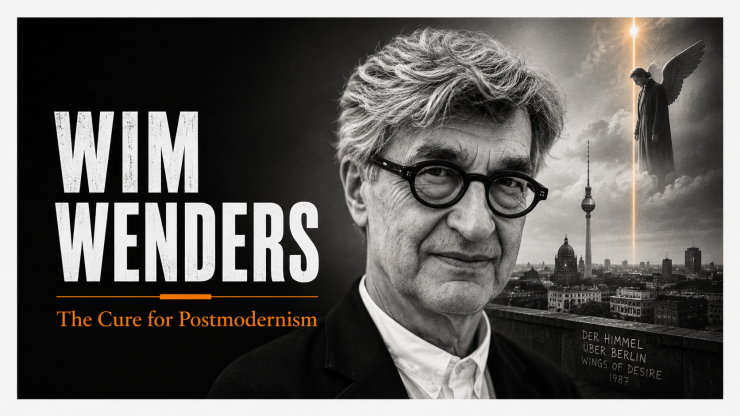
Wim Wenders, The Cure for Deconstruction
Vladimir Nemet
1. From The Name of the Rose to Pulp Fiction
There is a point in the history of Western culture when doubt displaced truth, and the method of deconstruction became more important than truth itself. Everything that for centuries had served as a firm ontological anchor — God, the subject, meaning, and even the very possibility of an authentic encounter with the Other — began to inexorably disintegrate. Deconstruction brought this process to its most sophisticated form: it revealed how behind every supposedly “eternal center” lies merely a temporary human construction, and how every “great meaning” can always be reopened, dismantled, and called into question.
This epochal rupture unfolded simultaneously in philosophy, psychoanalysis, and art. Freud opened a decisive space for this process when he showed that man is not master in his own house: behind the conscious Ego operate unconscious desires, conflicts, defenses, and relationships that shape his experience of reality. Psychoanalysis gradually developed into a psychodynamic understanding of the human being, according to which personality is not a closed and stable whole, but a living system of inner tensions, relationships, and unconscious forces. Later psychodynamic thought shifted the emphasis even further from the idea of a unified subject toward its relational and fragmented nature. The human being became a creature shaped through relationship with the Other, while the self was no longer a solid center but a space of continuous inner dynamics and dialogue, something particularly evident in the work of Heinz Kohut and Robert Stolorow.
Like psychoanalysis, art also sought, in its own way, to portray this process of fragmentation and deconstruction. What psychoanalysis discovered within the inner space of the human being, the art of film could render visible through image, space, montage, and relationships between characters. The fragmented subject, repressed memory, divided desire, projection, fantasy, and the impossibility of a direct encounter with the Other became cinematic structures. Psychoanalysis and film thus explored, in different ways, the same historical problem: what remains of the subject when we can no longer trust his own story about himself?
Within this theoretical and aesthetic sequence, the 1986 film The Name of the Rose, based on Umberto Eco’s novel, stands at the threshold of a new age, as an early and modest harbinger of postmodernism. In it, God, truth, and the sacred still possess full ontological weight and inner drama, but they have already become objects of doubt, interpretation, and deconstruction. Almost a decade later, Quentin Tarantino’s 1994 film Pulp Fiction brings this process to its culmination: great stories and metanarratives no longer need to be destroyed because they have already been destroyed. Irony, sarcasm, cynicism, and the absence of ultimate meaning are no longer problems to be resolved — they become the cinematic style itself and the dominant cultural atmosphere.
But precisely within this general disintegration, a radical cinematic anomaly appears: Wim Wenders.
His films Wings of Desire (1987) and Faraway, So Close! (1993) offer an almost direct resistance to this logic of deconstruction. It is important to emphasize, however, that Wenders does not come from some external, naïve space. He belongs to the same historical moment and knows the experience of postmodern deconstruction intimately. Yet, unlike its dominant sensibility, he does not derive its final word from deconstruction. While postmodernism flattens the vertical, Wenders persistently searches for it again. While the cinematic world dissolves into signs, quotations, and fragments, his films once again open a space for longing, for the radical alterity of the Other, for love, and for that which transcends the human being.
This essay therefore does not concern itself merely with the anatomy of postmodern deconstruction, but with its most important anomaly: Wim Wenders and the possibility that Wings of Desire may be one of the first authentic dawns of metamodern culture — a culture that emerges after deconstruction — a culture that does not restore the old center, but once again searches for the possibility of the vertical.
2. The Name of the Rose: The Deconstruction of the Vertical
The Name of the Rose appears at one of the important moments in European culture. Umberto Eco’s novel and Jean-Jacques Annaud’s film both carry within them a powerful postmodern suspicion toward the possibility of ultimate truth. Yet precisely because the story is set in a medieval monastery, this suspicion emerges against the background of a world that is still profoundly vertical.
It is a world in which God stands above man, truth possesses absolute value, the Church determines the boundaries of permissible thought, and heresy represents a deviation from truth. There is a hierarchy connecting the earthly and the heavenly, the visible and the invisible, man and God. The vertical is not merely a religious idea; it determines the entire structure of the world. Man knows that something exists above him and that his life derives its meaning precisely from his relationship to that which transcends him.
This verticality is perhaps most beautifully, but also most ambiguously, embodied in the monastery library. The library tower rises toward the sky, as though the architecture still affirmed the possibility of an ascent from earth toward truth. But the interior of the tower reveals something entirely different: the library is a labyrinth.
And it is precisely here that deconstruction begins.
The library is no longer simply a place where truth is stored and available to anyone who wishes to approach it. It becomes a labyrinth of signs. Books are no longer merely bearers of truth; they point toward other books, other texts, and other interpretations. A sign no longer leads simply toward its final meaning; it opens onto another sign. William of Baskerville attempts to reconstruct events through rational deduction, but the deeper he enters the world of signs, the clearer it becomes that reality is not transparent and that its meaning cannot simply be taken up as a ready-made truth.
Here the decisive shift takes place.
Truth is no longer something man simply receives from above. It becomes something that must be found, interpreted, and reconstructed. Between man and truth appears language. Between reality and its meaning appears the sign. Between God and man appears interpretation.
This is why The Name of the Rose is not merely a historical crime film. It is, in a sense, an allegory of the moment when Western culture begins to doubt its own verticals. God, truth, authority, tradition, and the sacred still exist, but they can no longer remain innocent. Everything that once appeared immediate must now pass through the question: who is speaking, from what position, in what language, and according to which interpretation?
This is precisely where the historical power of deconstruction lies. It does not begin by simply rejecting the vertical. First, it shows that what presented itself as absolute had always already been mediated by language, institutions, interpretations, and human interests. It does not destroy the vertical with a single blow. It deprives it of its self-evidence.
The vertical, therefore, does not collapse all at once.
It is gradually falling apart.
3. Pulp Fiction: The World After the Fall of the Vertical
If The Name of the Rose depicts the process of deconstructing the vertical, Pulp Fiction shows what a culture looks like in which that process is already largely complete.
Tarantino’s world is no longer a world of one great story. It is composed of countless stories, genres, styles, and quotations that intersect with one another. Time is no longer linear, identities are no longer stable, and different layers of culture can freely collide without any need to acknowledge a higher status in one another.
A biblical quotation can stand next to a conversation about hamburgers, philosophical reflection next to brutal violence, television culture next to questions of life and death. High and low no longer possess a fixed hierarchy. Everything can become a quotation.
But nothing has to be ultimate anymore.
This may be the most radical consequence of postmodern culture. The problem is no longer that there are too many meanings, but that there is no longer any privileged place from which we can say that one meaning is final. Every meaning can be questioned, reversed, quoted, or ironized. Even what once belonged to the realm of the sacred can become merely another element in an infinite network of cultural signs.
Even a religious text becomes a quotation.
In Pulp Fiction, there is no longer any need to destroy the great story. The great story has already been shattered. There is no need to prove that the world is fragmented — the very structure of the film becomes evidence of its fragmentation. Time breaks apart, genres intermingle, the serious becomes comic, the banal becomes philosophical, and violence can stand alongside everyday conversation without requiring any higher explanation.
The film no longer searches for a center.
It enjoys its absence.
This is why Pulp Fiction can be understood as an almost perfect image of the world after the fall of the vertical. It is not a world without meaning. On the contrary, meaning is everywhere. The problem is that no sign has the right to have the final word.
Everything can be connected to everything, but nothing is above everything.
Here postmodernism approaches its ultimate limit. After exposing the illusion of a single solid center, it is left facing a question it cannot answer: what if human beings cannot, after all, live without the vertical? What if the need for that which transcends the human being is not merely a remnant of the metaphysical past, but something deeply inscribed in human existence itself?
Postmodernism knew remarkably well how to show that the vertical can be constructed, how it can be abused, and how it can be deconstructed.
But it did not know what to do with the human longing for it.
For that, we need Wim Wenders.
4. Wings of Desire: Metamodernism Before Metamodernism
In 1987, just one year after The Name of the Rose, Wim Wenders made Wings of Desire. The film appeared at a moment when postmodern deconstruction had already profoundly marked the European intellectual and artistic landscape. And that is precisely why its opening seems almost unbelievable: there are angels above Berlin!
Wenders does not portray them ironically. He does not attempt to expose them as religious illusions, psychological projections, or remnants of some outdated metaphysical world. They simply exist. They move above the city, observe people, listen to their thoughts, and bear witness to their loneliness.
This idea itself is extraordinary courageous!
After a culture had learned to doubt the great narratives, after God had become one possible sign among other signs, Wenders once again introduces transcendence into the very structure of the cinematic world.
But he does not restore the old religion.
His angels are not guardians of a traditional metaphysical order. They are beings who observe the human world from outside and gradually begin to feel its attraction. The angel Damiel no longer wants merely to observe humanity. He wants to become human. He wants a body, touch, and love. He wants the possibility of suffering and mourning.
In other words, he wants to move from a space of complete security into a space of relationship.
This is one of the deepest paradoxes of the film: the angel, who possesses what from a traditional perspective might be regarded as perfection, longs for human imperfection. Immortality is no longer enough. Observation is no longer enough. He wants to be inside.
And what draws him inward is not some abstract “life,” but the possibility of encountering the Other.
Here Wenders makes his most important move. He does not restore the vertical by reestablishing God as the ultimate authority. The vertical appears as openness toward the Other. Transcendence is no longer primarily hierarchy, but relationship.
This is precisely why Wings of Desire is so close to what would much later be called metamodernism. Wenders does not return humanity to the world before deconstruction, but neither does he accept deconstruction as the final word.
It is possible to live after the collapse of old certainties and yet to long once again for that which transcends us.
A person can doubt and hope, know that there is no final answer, and still remain open to transcendence.
This is a metamodern intuition before it had acquired its name.
Wenders opens the sky again, but he does not claim to possess it.
5. Wenders as a Remedy for Deconstruction
Wenders is therefore not a “remedy” for deconstruction in the sense that what deconstruction has done should simply be undone. His importance lies precisely in the fact that he reveals its limit.
Deconstruction can show that many of our supposed verticals were constructions. It can show how authority, truth, and the sacred became intertwined with institutions, language, and power.
But it does not follow from this that human beings have ceased to be creatures who long for the Other.
This is what Wenders brings back to the center. After the vertical has been destroyed, the longing for it remains. After God has become a problem, the question of God remains. After transcendence has been deconstructed, there remains a human need for something to be greater than the human being.
Wenders does not turn this need into a new dogma. He leaves it open.
And this is precisely why Wings of Desire is so important for understanding the transition from postmodernism toward metamodernism. It does not restore the lost world; rather, it shows that after its loss, the vertical can appear again — but in a form different from the one that postmodernism rightly called into question.
Not the vertical of authority, but the vertical of the Other. Not certainty, but openness. Not a final answer, but longing.
This is why Wenders’s film is so unusual for its time. While it was relatively easy to deconstruct God, religion, angels, and grand narratives, Wenders dared to do something far more dangerous: to take them seriously again, without returning to the old metaphysics.
That is his courage.
The Name of the Rose shows how the old vertical comes apart.
Pulp Fiction shows the world that emerges after its fall.
Wings of Desire asks the question that comes after all of this: what if, despite everything we have learned from deconstruction, human beings still have to look upward?