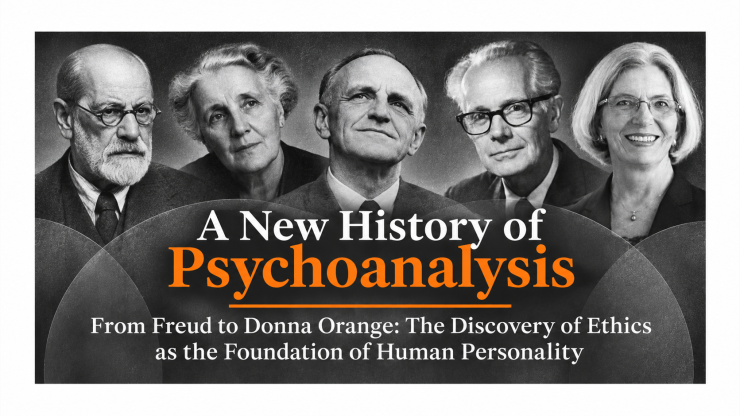
A New History of Psychoanalysis
From Freud to Donna Orange: The Discovery of Ethics as the Foundation of Human Personality
Vladimir Nemet
Introduction
Psychoanalysis has two histories: one that we know well and another that we have yet to tell.
The first begins with Freud’s discovery of the unconscious and continues through object relations theories, developmental psychology, theories of narcissism and the self, finding its contemporary continuation in relational and intersubjective approaches. This is the history of great theoretical discoveries, mutual criticism, and the gradual transformation of our understanding of the human psyche. Yet perhaps hidden behind this familiar history is another, much deeper and hitherto insufficiently recognized story: the history of the gradual discovery of ethics as the foundation of human personality.
It is possible that almost all the great psychoanalysts, from Freud and Melanie Klein through Winnicott, Bion, Kernberg, and Kohut, to Donna Orange, were actually speaking about the same phenomenon without being fully aware of it. They spoke about maternal care, the need for an object, recognition, empathy, reparation, the capacity for concern for another, idealization, and reciprocity. They described different forms of human dependence on others, but also something much deeper: the possibility that another human being can become immeasurably important to us. In doing so, they employed different, sometimes seemingly incompatible theoretical languages, without recognizing that they might be describing different manifestations of one and the same universal reality.
Only today can we attempt to connect these seemingly distant theoretical paths and recognize what they have in common. For what lies behind them is not merely the need for another human being, but something much more fundamental: the need for another to matter, for us to care about them, and for ourselves to matter to someone else.
In other words, underlying the various psychoanalytic theories and therapeutic methods is one and the same phenomenon – ethics.
Not ethics as a set of moral rules, social norms, or cultural conventions, but ethics as an original human capacity and need for another human being to matter to us. This is a dimension of human existence that belongs to no particular historical period or culture, because it precedes every culture and every theoretical attempt to explain it.
Indeed, the importance of a mother’s care for her child has not changed throughout human history. A child has always needed someone to see, recognize, protect, and care for them. Cultures, family structures, social values, and theoretical explanations of psychological development have changed, but the fundamental human need to matter to someone has not. Ethics did not emerge with philosophy, religion, or modern society. It is neither a product of social agreement nor a historically variable convention. It is older than every attempt by human beings to name, explain, or regulate it through norms. Its earliest traces are not found in philosophical debates, but in the earliest human relationship: the encounter between a child and the person who cares for them.
But if ethics is so fundamental to human existence, a question inevitably arises: why has psychoanalysis failed to recognize ethics as one of its central theoretical premises? Is this a matter of the historical limitations of psychoanalytic thought, or is it something that psychoanalysis itself, despite all its discoveries, has found difficult to accept?
The Limitations of the Times
The answer to why psychoanalysis did not recognize ethics earlier as the foundation of human personality must be sought in the intellectual and epistemological limitations of the times in which its most significant representatives developed their theories. The point is not that different psychoanalysts gradually created or discovered different forms of ethics, but that each, from within their own theoretical perspective, encountered different manifestations of one and the same universal ethical reality without managing to recognize it in its entirety. Their concepts, theories, and clinical approaches were different, but behind them the same insufficiently articulated question kept emerging: what makes another human being so important that, without their care, recognition, and presence, we cannot become who we are?
It is precisely here that metamodern psychoanalysis opens the possibility of a different understanding of personality. Answering this question requires not merely an expansion of existing theories, but a transformation of the very ontology of psychoanalytic thought. The other person is no longer merely an object of our drives, projections, needs, or developmental expectations. Nor are they simply a participant in an intersubjective relationship with whom we negotiate our own identity. The other is constitutive of our existence. Ethics is not an additional element of psychological development, nor is care merely one of its desirable consequences. On the contrary, care is one of the original possibilities of human existence, and the ethical vertical gives the I–Thou relationship its deepest ontological dimension.
Perhaps the time has therefore come to tell the history of psychoanalysis anew. Not as a history of theories that succeeded, supplemented, and challenged one another, but as the history of the slow, incomplete, and often unconscious discovery of a truth that has always been before us. A truth that psychoanalysis could not fully articulate because it did not yet possess the concepts necessary to recognize it.
For a human being does not become human merely by learning to live with themselves, understand themselves, or construct their own identity.
A human being becomes human because they matter immeasurably to someone else and because another human being can become immeasurably important to them. It is precisely in this mutual significance that human personality begins.
Five Milestones on the Path to Discovering Ethics
To understand how ethics gradually emerged throughout the history of psychoanalysis, we must return to its most important theoretical turning points. However, we will not follow the conventional history of psychoanalytic schools, their mutual conflicts, and their theoretical disagreements. We will attempt something different: to read familiar psychoanalytic theories from the perspective of what has never been sufficiently recognized within them – the universal ethical nature of human personality.
We begin with the assumption that the fundamental human need for care, recognition, and the significance of the Other has not changed throughout human history. A child has always needed someone to care for them, recognize their needs, and respond to their vulnerability. This need is not a product of a particular culture, social order, or historical period. It precedes all theories, philosophies, and attempts to explain it. Psychoanalysis did not create this reality; rather, throughout its development, it gradually discovered its various psychological manifestations.
Interestingly, this discovery almost never took place through the direct investigation of ethics. Psychoanalysts did not begin by asking what it means to be an ethical being, but rather by addressing concrete clinical problems: unconscious conflicts, aggression, envy, guilt, relationships with primary objects, the development of the self, narcissism, and the therapeutic relationship. Yet these very investigations, often contrary to their initial theoretical assumptions, brought them ever closer to a deeper reality: human personality cannot be understood without care for the Other and without the experience of one’s own significance in the Other’s world.
Each of these authors, in their own way, opened the door to one dimension of the same reality. What appears in Freud, concealed behind guilt and internal conflict, takes the form of reparation in Klein. What Winnicott recognized as the capacity for concern for the Other reemerges in Kohut through idealization and the need for an immeasurably important Other. In contemporary intersubjective psychoanalysis, particularly in Donna Orange, ethical responsibility begins to acquire explicit theoretical significance. We will not view these concepts merely as separate psychoanalytic discoveries, but will attempt to demonstrate their interconnectedness and their shared ethical foundation.
There were also reasons why ethics could not be articulated directly.
Psychoanalysis had to establish its own scientific identity, distinguish itself from philosophy and religion, and explain the human psyche through concepts acceptable within the scientific discourse of the time. Later, the postmodern critique of universal truths and distrust of grand narratives further complicated the possibility of establishing ethics as a universal foundation of human existence.
The five authors and five theoretical milestones we will examine therefore do not represent five different ethics or five separate discoveries. They represent five different encounters with one reality that has always been present in human existence, but which psychoanalysis has been unable to grasp in its entirety.
Perhaps this is precisely the history that psychoanalysis has yet to tell.
Five Milestones
1. Sigmund Freud – Guilt and the Unconscious Significance of the Other
Freud’s discovery of the unconscious opened an entirely new perspective on understanding human personality. Human beings were no longer masters of their own thoughts, feelings, and actions, but beings whose lives were governed by unconscious conflicts, repressed desires, and ambivalent feelings. Freud’s understanding of guilt, conscience, and the formation of the superego is particularly important. In his theory, the child gradually internalizes parental prohibitions, while the fear of losing parental love and approval becomes one of the sources of the psychological structure that will later regulate their relationships and behavior.
However, Freud’s theory can also be read from a different perspective. Why does it matter so much to a child how their parent sees them? Why does the loss of parental love produce such intense anxiety? Why does a child feel guilty even when no one knows about their aggressive fantasies? Perhaps behind these questions lies something Freud did not fully recognize: the child is attached to the parent not merely because of drive gratification, fear of punishment, or the need for protection. The parent matters to the child on a much deeper level – as the Other whose recognition, love, and presence have a constitutive significance for the child’s existence.
From this perspective, guilt can also be understood as an unconscious trace of an ethical bond with the Other. It need not be merely the consequence of fear of punishment or internalized prohibitions; it may also contain the recognition that we have hurt someone who is immeasurably important to us. Freud discovered the psychological force of guilt, but did not sufficiently explore the possibility that behind it lies an original human need to preserve the significance of the Other. His theory remained strongly shaped by a drive-based and conflict-oriented understanding of the psyche, which prevented the ethical dimension of relationships from becoming its fundamental organizing principle.
2. Melanie Klein – Reparation and the Discovery of Responsibility for the Other
Melanie Klein took an important step toward understanding the ethical dimension of human personality. Her theory shows that, from the earliest stages of life, a child does not experience others merely as sources of gratification or frustration, but develops a complex emotional relationship with them. At the center of her understanding of psychological development lies the ambivalence of love and aggression, or the possibility that a child can simultaneously love and hate the person on whom they are entirely dependent.
Her concept of reparation is particularly important. In the depressive position, the child gradually recognizes that the object of their love is the same object toward which they feel aggression. A fear emerges that their own aggression has hurt or destroyed this object, together with a desire to restore, protect, and preserve it. Reparation thus goes beyond the mere reduction of one’s own guilt. It involves an emotional recognition of the object’s significance and a desire for its well-being. It is precisely here that we can recognize one of the earliest and most important psychoanalytic manifestations of ethics.
From a metamodern perspective, the question of why it matters so much to us that an object we have hurt should be well again is particularly interesting. If this were merely a matter of reducing internal anxiety or restoring integration, it would be difficult to explain why reparation involves such a strong orientation toward the well-being of the Other. Perhaps its deeper meaning lies in the fact that the child begins to experience the Other as someone whose significance exceeds their own needs and fantasies. Reparation is then not merely an attempt to repair an internal object, but an expression of care for someone who exists beyond our own psychic world.
Thus, although Klein did not use the language of ethics, she described an important moment in its psychological manifestation: the moment when the well-being of the Other becomes important to us. Nevertheless, her understanding remains largely tied to the dynamics of aggression, guilt, integration, and internal objects. She did not fully explore the question of whether care for the Other might be something more original than a consequence of overcoming aggressive fantasies.
3. Donald Winnicott – Capacity for Concern: Ethics as the Foundation of Human Maturity
Winnicott perhaps came closer than any other classical psychoanalyst to the discovery of ethics. His concept of Capacity for Concern refers to a child’s ability to recognize the significance of another person, to care for them, and to feel responsible for their own actions toward them. In contrast to approaches that primarily associate psychological maturity with integration, autonomy, or drive control, Winnicott recognizes care for the Other as one of the key dimensions of emotional maturity.
It is particularly significant that this capacity develops within a relationship with a mother who can withstand both the child’s love and aggression. The child gradually discovers that the person they love and the person toward whom they direct destructive impulses cannot be separated. The mother remains present despite the child’s aggression, and her ability to survive these attacks enables the child to develop concern for her. Care thus emerges within a relational space in which the Other ceases to be merely an extension of one’s own needs.
However, Winnicott’s concept also raises a question that goes beyond his theory. Is care for the Other merely a developmental capacity gradually shaped by a sufficiently good maternal environment, or is it an original human possibility that requires an appropriate relationship in order to be realized? From a metamodern perspective, we can assume that care is not merely a developmental achievement, but one of the fundamental possibilities of human existence. A child does not first have to become an integrated person in order to be ethically connected to the Other. On the contrary, the experience of mattering to someone and of the Other mattering to us contributes to the emergence of what we later call personality.
Winnicott thus opened the door to understanding ethics as an integral part of psychological health. Nevertheless, he did not fully develop the ontological implications of his own discovery. Care remained largely described as a developmental capacity rather than as a fundamental dimension of the I–Thou relationship and human existence.
4. Heinz Kohut – Idealization and the Immeasurable Significance of the Other
Kohut made a particularly important contribution to the history of psychoanalysis by reopening the question of the need for an Other who has extraordinary significance for our existence. His psychology of the self shows that human beings need more than drive gratification, protection, or emotional support. They need an Other whom they can admire, idealize, and alongside whom they can experience a sense of security, meaning, and psychological strength. The need for an idealized selfobject is not merely a sign of developmental immaturity, but a lasting dimension of human life.
An important ethical possibility is concealed within idealization. The idealized Other is not merely someone to whom we attribute special abilities, but someone whose presence is immeasurably important to us. Their value exceeds the ordinary exchange of needs and gratification. They become a source of support for our existence, someone to whom we can entrust our vulnerability and whose significance cannot be reduced to what they provide us with. In this sense, Kohut reopened a question that Freud’s drive theory had pushed aside: the human need to recognize something greater and more important than oneself in the Other.
However, Kohut primarily understood this need through the development and maintenance of self-cohesion. His concept of transmuting internalization describes how the functions of the idealized selfobject are gradually transferred into the individual’s psychological structure. From a metamodern perspective, this is precisely where the possibility of a different reading of his theory emerges. Perhaps the goal of therapy is not for the idealized Other to gradually lose their special significance through internalization, but for their vertical significance to be transformed. Omnipotent idealization can become ethical idealization: instead of the Other mattering because of their imagined perfection and power, they become important because of their capacity for care, responsibility, and the preservation of another human being.
Kohut, therefore, developed the methods and clinical conditions for activating idealization extraordinarily well, but did not sufficiently develop its ethical dimension. His theory offers the possibility of understanding idealization once again as a path toward discovering the immeasurable significance of the Other, rather than merely as a developmental process contributing to the stability of the self.
5. Donna Orange – Ethical Responsibility as the Foundation of the Therapeutic Relationship
With Donna Orange, the ethical dimension of psychoanalysis acquires a much more explicit theoretical significance. Drawing particularly on Levinas, Orange abandons the notion that the therapeutic relationship can be understood primarily through technique, neutrality, and theoretical explanations of the patient’s psychological life. The therapist does not encounter merely a clinical case, symptoms, or unconscious conflicts, but another human being toward whom they have a responsibility. This responsibility is not a subsequent consequence of professional rules; it precedes every attempt at understanding.
This represents an important shift. A therapist does not become ethical only by applying an appropriate technique or successfully interpreting a patient’s conflicts. The ethical dimension of therapy is already present in the way the therapist approaches another human being, listens to them, bears their vulnerability, and responds to their suffering. The Other is not an object of our knowledge, but a person whose significance makes a demand upon us. In this sense, Orange brings psychoanalysis closer to Levinas’s idea that responsibility toward the Other precedes our freedom and our theoretical understanding of the world.
Nevertheless, a metamodern perspective can raise another question. How can ethical responsibility be connected with the development of personality, idealization, and the experience of the immeasurable significance of the Other? If the therapist is responsible for the patient, what happens when the patient cannot recognize that responsibility, rejects it, or attacks and humiliates the therapist? It is precisely in such moments that ethics reveals itself not merely as a philosophical premise of therapy, but as a concrete relational experience. The therapist’s care must remain present even when the patient cannot reciprocate, recognize, or accept it.
Here an opportunity emerges to connect Orange with Winnicott and Kohut. From Winnicott, we take the understanding of care as a fundamental capacity of human personality; from Kohut, the importance of idealization and the possibility of the therapist becoming an immeasurably important Other. Orange helps us understand that such significance must have ethical substance. The therapist need not be omnipotent, infallible, or perfect. Their special significance arises from their ability to remain in the relationship, to care even when the relationship becomes difficult, and to demonstrate through their very presence that the patient’s significance has not disappeared.
Orange thus took an important step toward explicitly naming ethics in psychoanalysis. Nevertheless, there remains room for a theory that would connect ethical responsibility, developmental psychology, idealization, and the very ontology of human personality. This is precisely where metamodern psychoanalysis attempts to take the next step.
What Connects These Five Milestones?
When we consider them together, it becomes apparent that throughout the history of psychoanalysis a question has gradually emerged that none of these theories has fully placed at its center: why is the Other so important to us, and what does that importance mean for our existence?
- Freud shows us how deeply the Other participates in the formation of our conscience and guilt.
- Klein reveals that the well-being of the Other can become important to us independently of our own gratification.
- Winnicott recognizes care for the Other as an important capacity of emotional maturity.
- Kohut discovers our need for an Other to whom we can attribute immeasurable significance.
- Orange places ethical responsibility toward the Other at the very center of the therapeutic relationship.
These are not five different ethics, but five different perspectives on one universal reality. Each author illuminated part of it, while simultaneously remaining within the theoretical limitations of their own time.
Metamodern psychoanalysis attempts to accomplish what previous theories did not: to recognize ethics not as one dimension of human personality, but as its foundation.
Conclusion: From the Discovery of Ethics to a New Paradigm of Psychoanalysis
When we reread Freud, Melanie Klein, Winnicott, Kohut, and Donna Orange today, we can discern something they share, even though it was never sufficiently clearly articulated in their theories. Behind unconscious conflicts, guilt, reparation, the capacity for concern, idealization, and ethical responsibility, the same human reality continually emerges: the need for the Other to matter to us and for ourselves to matter immeasurably to the Other. What remained concealed behind psychological conflict in one theory appeared in another as a developmental capacity, and in a third as an explicit ethical responsibility. Different theoretical languages gradually illuminated different aspects of one and the same reality.
Nevertheless, a significant gap remained between these discoveries and their eventual theoretical integration. Psychoanalysis knew a great deal about the human need for the Other, but it did not fully recognize what this need means for the very ontology of human personality. The Other largely remained an object of drive investments, internal fantasies, developmental needs, or a participant in an intersubjective relationship. Even when care became a central clinical and theoretical concept, its ontological implications were not sufficiently explored.
A metamodern perspective attempts to take precisely this step. It does not reject previous psychoanalytic theories, but rereads them from the perspective of their insufficiently recognized ethical foundation. Care is not merely one of our emotional capacities, nor is ethics simply a desirable consequence of healthy development. Ethics is something much more fundamental: it is one of the original dimensions of human existence. Human beings do not first exist as independent, self-contained personalities who subsequently enter into relationships. Their existence is marked by the Other from the very beginning. Without the experience of mattering to someone and without the possibility of another becoming immeasurably important to us, we cannot understand either the emergence or the depth of human personality.
This also requires a different understanding of psychotherapy. Its purpose is not exhausted by the removal of symptoms, the integration of the self, the resolution of unconscious conflicts, or the establishment of more functional relationships. At its center lies the possibility of reestablishing an ethical connection with the Other. Patients often suffer not merely because they were insufficiently loved, recognized, or accepted, but because they have lost the experience of their own immeasurable significance to someone. Their ontological hunger cannot be satisfied merely by explaining their own conflicts. What is needed is a renewed experience of an Other who is willing to care for them, remain present, and preserve their significance even when the relationship becomes difficult.
In this sense, metamodern psychoanalysis retains Kohut’s ability to activate idealization, Winnicott’s understanding of care, and Donna Orange’s ethical responsibility, while bringing them together into a different theoretical framework. Its goal is not to create a self-sufficient personality that no longer needs the Other, but to make it possible for a human being to bear the immeasurable significance of the Other without losing their own uniqueness. This is neither a return to symbiosis nor an attempt at the ultimate merging of two personalities. It is a matter of sustaining the relationship between two irreplaceable and mutually irreducible dimensions of human existence: the Great I and the Great Thou.
Perhaps this is why the history of psychoanalysis itself needs to be told differently. Its deepest history is not merely the history of the discovery of the unconscious, drives, objects, the self, or intersubjectivity. It is also the history of a gradual approach toward the truth that human personality cannot exist without the ethical significance of the Other. Freud opened the door to the unconscious, Klein demonstrated the power of reparation, Winnicott recognized the capacity for care, Kohut rediscovered the immeasurable significance of the idealized Other, and Orange made ethical responsibility an explicit subject of psychoanalytic thought. What remains is to connect these discoveries and recognize their shared ontological foundation.
Ethics, therefore, is not the final chapter in the history of psychoanalysis. Perhaps it has been its unrecognized first chapter all along.