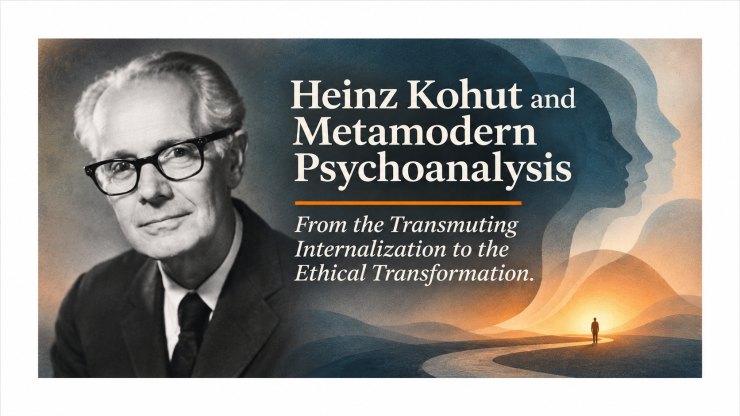
Heinz Kohut and Metamodern Psychoanalysis
From the Transmuting Internalization to the Ethical Transformation
Vladimir Nemet
The Narrowed Horizons of Contemporary Psychoanalysis
Contemporary psychoanalysis, despite its theoretical diversity and growing sensitivity to interpersonal relationships, faces an unusual paradox – it speaks of vulnerability, mutuality, empathy, and intersubjectivity, yet less and less of human greatness and significance. In its effort to abandon old hierarchies, authorities, and pathological forms of grandiosity, psychoanalysis seems to have gradually lost its sense of the human need for something exalted. Human beings have become more understandable in their vulnerability, but at the same time less understandable in their longing for the absolute.
This development is not without consequences. Human experience is increasingly described in the language of horizontal relationships: affect regulation, emotional availability, adaptation, mutual recognition, and the capacity to maintain psychological equilibrium. These are all important dimensions of psychic life, but they do not exhaust human existence. We do not seek merely to be accepted, understood, and emotionally regulated. We also seek someone we can admire, someone whose greatness transcends us, just as we simultaneously wish to be recognized as someone who transcends the limits of ordinary existence. There is, therefore, something that cannot be reduced to a horizontal exchange between two psychological subjects. Immanence also seeks transcendence. Human beings are not merely a horizontal rhizome, a network of underground roots, as Deleuze and Guattari describe it, but also vertical trees standing among other trees.
It is precisely here that a question often overlooked by contemporary psychoanalysis emerges: what happens to the human need for greatness when it can no longer be understood exclusively as an expression of narcissism? Is every idealization a defense against insecurity? Is every admiration an attempt to escape one’s own helplessness? And must psychological maturity necessarily mean abandoning the need for an Other who is greater than ourselves?
A return to Heinz Kohut opens the possibility of a different answer. Kohut had the courage to liberate narcissism from exclusively pathological interpretations and to recognize in it a permanent developmental dimension of human existence. His theory of the bipolar self is important not only because of its new understanding of narcissistic development, but also because it contains a much broader insight: human beings are shaped by the tension between the need to be great and the need to admire the greatness of the Other.
In the language of Metamodern Psychoanalysis, this concerns two fundamental verticals: the Great I and the Great You. Kohut did not formulate them in these terms, but he recognized their psychological architecture. This is precisely why his work represents an important precursor to metamodern psychoanalysis.
Kohut’s Tension Arc: Between the Great I and the Great You
Kohut’s decisive contribution to psychoanalysis stems from his refusal to view narcissism merely as a developmental phase that must be overcome in favor of mature object love. For him, narcissism is not a remnant of infantile omnipotence that must disappear in the course of development. It represents a distinct developmental line, permanently present throughout human life, from which ambitions, ideals, creativity, and a sense of self-worth emerge. We do not cease to be narcissistic beings when we become mature. What changes is the way we live our narcissism.
At the center of Kohut’s bipolar self lie the grandiose-exhibitionistic self and the idealized parent imago. The former can be understood as the vertical of the Great I, and the latter as the vertical of the Great You. Although they are developmentally and psychologically distinct, both poles arise from the same fundamental need: the need to participate in something that transcends the limitations of ordinary, everyday existence.
The Great I is rooted in the archaic experience of one’s own omnipotence: I am perfect, and you are a part of me. In this experience, the world does not yet possess an independent greatness. The Other is an extension of one’s own existence, a mirror in which one’s grandiosity is affirmed. The need for mirroring is not merely a desire for praise. It is much more fundamental: the need for someone to recognize our significance, to see us as beings whose existence is neither accidental nor interchangeable.
The Great You represents the opposite direction of the same longing: You are perfect, and I am a part of you. Here, greatness is not sought in one’s own omnipotence, but in the Other. The idealized parent is not merely someone who provides security. They are the bearer of strength, wisdom, and perfection, someone whose greatness the subject wishes to approach and participate in. In their presence, one’s own limitations become bearable because the subject feels part of something greater than themselves. This is also the foundation of religious experience.
Between these two aspirations, Kohut places what he calls the tension arc. Its significance lies precisely in the fact that development does not occur by simply abandoning one pole and moving toward the other. The ambitions of the Great I and the ideals of the Great You remain in constant interaction. We want to be recognized, but we also want someone we can idealize. We want our own greatness, but we do not want to be the only greatness in the world. Our existence is marked by the tension between self-affirmation and admiration. It is important to emphasize that this is not a conflict but a paradox. Unlike a conflict, a paradox has no resolution.
This tension is what gives human experience its vertical dimension. It is not merely psychological energy that drives development, but also a space in which the possibility of transcendence emerges. We are shaped not exclusively by what we are, but also by what we aspire to and by what we admire. Without the Great I, the possibility of our own elevation is lost; without the Great You, the possibility of encountering something that transcends us is lost.
Probably no one before Kohut attempted such an exhaustive explanation of how experiences of greatness and religious feeling are activated in psychotherapy. He also recognized the resistances that prevent their emergence, making his psychology of the personality possible to understand as an analysis of the resistances that obstruct the development of the Great I and the Great You.
Kohut recognized that these two needs cannot simply be eliminated without impoverishing human existence. Yet precisely where his theory opens one of the most important questions in psychoanalysis, its fundamental limitation also emerges.
Internalization and the Loss of the Other: The Limits of Kohut’s Theory
Kohut’s understanding of the bipolar self rests on the assumption that psychic development takes place through relationships with selfobjects, that is, through experiences in which the Other participates in maintaining and shaping the subject’s self. The child does not possess all the psychological capacities necessary to maintain their own cohesion. Initially, these capacities are found in the Other. However, development does not end with this dependence. Through repeated experiences of optimal frustration, functions previously provided by selfobjects are gradually internalized. Kohut calls this process transmuting internalization.
This explanation has considerable clinical value. It demonstrates how psychic structures develop within relationships rather than independently of them. Nevertheless, at the theoretical level, a question arises that Kohut did not fully explore: what happens to the Other when their functions become part of the subject’s psychic structure? Is development truly complete when we can provide ourselves with what we once needed from the Other?
This is precisely where the problem of internalization emerges. What initially existed outside the subject, what transcended them and gave them a sense of connection with something greater, gradually becomes an internal capacity. The Great You becomes part of the psychic organization of the Great I. The vertical is relocated within the subject, and the relationship with the Other begins to be understood in terms of what can be assimilated from it.
But can the greatness of the Other really be transformed into our own greatness? Is this not precisely the contradiction? If the Other is great only insofar as they provide us with something we do not yet possess, then their greatness has a limited developmental lifespan. Once their functions become our own, their irreplaceability is lost. What was once transcendence becomes a psychological capacity, and what once exceeded us becomes part of what we are.
This is not a rejection of the development of internal psychic capacities. We undoubtedly need to develop the ability to self-regulate, to trust ourselves, and to maintain our own cohesion. However, such development does not necessarily mean that the Other ceases to be needed as someone who exists beyond us and whose significance cannot be exhausted by our psychological needs. There is a difference between being able to live without constant support from the Other and believing that the Other is no longer needed as a source of greatness, meaning, and ethical experience.
Kohut’s theory does not fully resolve this distinction. It recognizes the developmental value of relationships, but their ultimate meaning is nevertheless sought predominantly in the changes that take place within the subject. This opens the possibility that psychological autonomy becomes the measure of maturity, while the Other becomes merely a temporary participant in the construction of our inner world.
In this deconstruction of ideals, I recognize the influence of postmodern culture, which questions verticality and seeks to dismantle it. This approach stands in contrast to the philosophy of Emmanuel Levinas, according to which Otherness cannot be reduced to something that can be exhausted by our understanding, needs, or psychological capacities. The Other is not merely what they give us, but also what always remains beyond us.
This is why Metamodern Psychoanalysis does not fully agree with Kohut. It does not reject psychic development or the need for inner stability, but it rejects the conclusion that maturity requires diminishing the significance of the Other. The Great You cannot be exhausted by the internalization of its functions, just as the Great I cannot be reduced to an internal structure that no longer needs encounter. Their greatness is not merely a means of development. It is one of the fundamental dimensions of human existence.
The Metamodern Transformation of Idealization: From Omnipotence to Ethics
If the problem with Kohut’s theory lies in the fact that the verticality of the Other is gradually subordinated to the development of internal psychic structures, then the question arises whether idealization can be understood differently. Can its developmental transformation take place without the disappearance of what is being idealized? In other words, can the nature of greatness change without losing the need for a Great Other itself?
The metamodern understanding of idealization proposes precisely such a shift. It does not attempt to eliminate the archaic need for omnipotence, but to transform its content. Initially, the greatness of the Other is most often experienced through strength, knowledge, and beauty. The child idealizes the parent because they seem capable of everything, know everything, and are impervious to danger. Such idealization is not accidental. It belongs to a world in which physical and psychological security are inseparable from the experience of an omnipotent Other.
However, human greatness need not remain tied to these categories. There is another possibility of idealization, in which the exalted is no longer recognized primarily in power, infallibility, or perfection, but in the capacity to care. This is the transition from the idealization of omnipotence to the idealization of ethics.
In this transition, the meaning of the Great You also changes. The Other is no longer great because they can do everything, know everything, or protect us from every danger. Their greatness manifests itself in their ability to recognize us as significant, to care for us, and to not experience our vulnerability as a reason to withdraw. Their greatness lies not in the absence of limitations, but in their capacity to remain ethically present despite their own limitations.
Such idealization is not based on an illusion of perfection. It is based on the recognition of something more important than perfection: the capacity to experience the Other as infinitely significant. The Great You does not become less great when they reveal their own vulnerability. On the contrary, their greatness no longer needs to be proven through omnipotence. It is revealed through care.
At the same time, the Great I is also transformed. Its greatness is no longer determined by the need to be the center of the world or by the demand for constant affirmation from the Other. It is realized in the capacity to recognize the greatness of the Other and to respond to it. The subject does not abandon their own vertical, but discovers that it cannot be realized independently of the vertical of the Other.
Here, an essential distinction between ethics and morality also emerges. Ethical greatness is not obedience to rules, adaptation to social expectations, or the renunciation of one’s own existence. It arises from the immediate experience of the significance of the Other. Care is not a duty subsequently imposed upon a relationship, but the way in which the meaning of the Other is revealed in the first place. In this sense, ethics is not an addition to psychological development, but its deeper ontological dimension.
Transmuting internalization must therefore be understood differently within this framework. Its purpose is not to extinguish the greatness of the Other by turning it into an internal function, but to transform the very capacity for idealization. What changes is not the need for the Other, but the way their greatness is recognized. From omnipotence to care, from infallibility to responsibility, from fascination with perfection to ethical recognition.
The metamodern transformation therefore does not abolish the tension arc between the Great I and the Great You. It liberates it from the need for omnipotence and opens it to the ethical dimension of existence. The Great You remains outside the Great I, but is no longer an unattainable figure of perfection. The Great I remains an independent vertical, but no longer seeks its greatness in superiority over the Other. Their relationship does not end in fusion or final resolution. It remains alive precisely because neither side can replace the other.
Conclusion: The Greatness of the Other and the Future of Psychoanalysis
Kohut returned to psychoanalysis something it had gradually lost in its development: a serious understanding of the human need for idealization, admiration, and greatness. His discovery of the bipolar self demonstrated that human existence cannot be understood solely through relationships, drives, and adaptation. We live between two fundamental aspirations: to be recognized in our own significance and to find someone whose greatness we can admire. The vertical dimension of human experience emerges within this tension arc.
Nevertheless, Kohut did not fully follow his own discovery. His theory of transmuting internalization remained tied to the assumption that the developmental value of the Other gradually becomes an internal psychic capacity. This opened the possibility of understanding relationships as a path toward increasing autonomy rather than as a permanent dimension of human existence. The Great You becomes something the subject can carry within themselves, rather than remaining someone whose significance cannot be exhausted by what they have left inside us.
Metamodern Psychoanalysis attempts to cross this boundary. It does not reject Kohut’s discovery, but seeks to complete it. It does not seek the abolition of idealization, but its transformation. It does not seek the disappearance of the vertical, but a change in its foundation. Human greatness no longer needs to be demonstrated through strength, knowledge, and beauty. It can be realized in the capacity to recognize the Other as significant, to preserve their irreducible difference, and to respond to their presence with care.
In this understanding, psychological maturity does not mean that we have become self-sufficient, but that we are capable of enduring the existence of the Other without the need to appropriate them. We do not have to turn them into a part of ourselves in order to preserve their significance. On the contrary, only when we cease to demand that the Other become ours does the possibility of truly encountering them emerge.
Perhaps this is the greatest paradox of human existence: we do not discover our own greatness by becoming greater than the Other, but by becoming capable of recognizing their greatness.