From Selfobject to Subjectobject
Vladimir Nemet
“Once upon a time, Zhuangzi dreamed he was a butterfly. He was a butterfly, fluttering about and enjoying himself, unaware that he was Zhuangzi. When he awoke, he no longer knew whether he was Zhuangzi who had dreamed he was a butterfly, or a butterfly dreaming he was Zhuangzi.”
Fragment from an ancient Chinese philosophical story, 4th century BCE.
This ancient Chinese story raises a question that has accompanied the entire history of human thought: who is the subject, and who is the object of our experience? Does the world exist independently of us, or is it, at least in part, a product of our subjectivity? Are we the ones who observe and shape others, or are we simultaneously the objects of their observation and shaping? In short: are we created by others, or do we create others?
The history of humankind can be understood as a history of the continuous shifting of the relationship between subject and object:
In the premodern era, human beings were understood primarily as God’s creation, and the world as an expression of divine invention. From this perspective, human beings were first and foremost objects of God’s creation, while their right to their own subjectivity remained subordinate to the divine will.
The modern era brought about a major reversal. The subject became the center of knowledge, and the world was increasingly understood through human perception, reason, and experience. The world thus became the object of the subject’s knowledge and projection. Human beings were no longer merely creatures of the world but also its interpreters, creators of meaning, and measures of reality.
Postmodernism, seeking to free itself from the apparent stability and universality of such positions, deconstructed their foundations. It exposed the historical, cultural, and linguistic projections that had shaped our conceptions of reality. In doing so, it called into question not only the authority of the subject but also the possibility of an object existing independently of our interpretations. Subject and object lost the firm foundations they had once possessed.
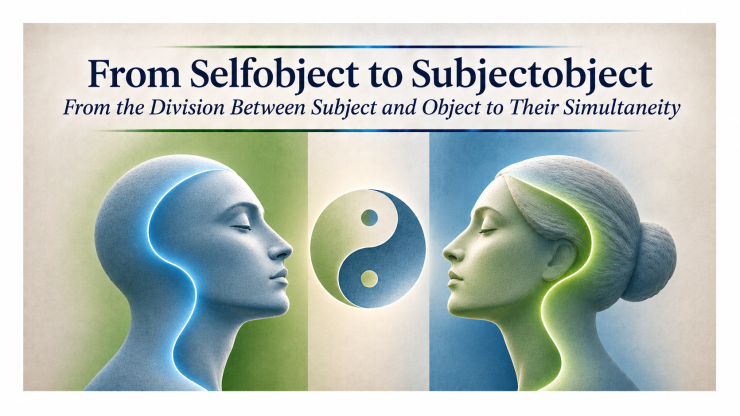
The metamodern era opens up a different possibility. Rather than choosing between subject and object, it allows them to exist simultaneously. The projections of subject and object are not mutually exclusive: I shape the Other, but the Other also shapes me; I am the subject of the Other’s experience, while simultaneously being the object of the Other’s subjectivity. The Other is not merely my projection, just as I am not merely the Other’s. We are both simultaneously observers and observed in relation to one another, while our subjectivity can never be entirely reduced to the subjectivity of the Other.
For this reciprocal yet irreducible relationship, I propose the concept of the subjectobject.
With this concept, I seek to overcome the limitations of Kohut’s well-known concept of the selfobject. The latter defines the Other primarily in terms of the function they perform for the self.
However, our personality is always shaped by Otherness, never by a function. Behind every activity that we believe contributes to the formation of our psychological structure, we sooner or later discover the presence of another person. Behind every activity there is always someone, not something; always a person, never a function.
The concept of the subjectobject implies the Other as an independent subjectivity, but also as an indispensable part of our own existence. In this way, I seek to establish the foundations of a different psychoanalytic paradigm: a paradigm of two subjectivities that create, shape, and transform one another, yet can never be entirely reduced to one another.
Kohut’s Concept of the Selfobject
Heinz Kohut introduced the concept of the selfobject to describe a particular kind of relationship in which another person participates in the development, maintenance, and cohesion of our self. Starting from the assumption that the self does not develop independently of its environment, Kohut emphasized that we need other people not only to satisfy our emotional needs but also to maintain our sense of identity, worth, and psychological stability.
The concept of the selfobject refers to the function of another person whom we experience not merely as a separate and distinct being, but also as someone who participates in the functioning of our self. Their presence, responses, and reactions enable us to maintain and develop various dimensions of our psychological experience.
Kohut described three fundamental selfobject needs:
The need for mirroring refers to the need for recognition, acceptance, and affirmation of our own worth. The need for idealization allows us to rely on the strength, calmness, and greatness of the Other and, through our connection with them, to experience security and stability. Later, Kohut also introduced the need for twinship, which refers to the experience of togetherness and recognizing ourselves in others.
According to Kohut, these needs do not disappear with the end of childhood but remain present throughout life. Maturity does not mean the cessation of our need for the Other, but rather the ability to maintain relationships more flexibly and tolerate inevitable disappointments. In this context, the concept of optimal frustration is important: an experience of limited disappointment that enables the development of internal psychological structures through the process of transmuting internalization.
In psychotherapy, the therapist can become a selfobject for the client, providing experiences of mirroring, idealization, and belonging that may have been insufficient in earlier relationships. Empathy, in this context, represents the fundamental method of understanding the client’s subjective world.
Kohut’s concept of the selfobject thus brought about an important shift in psychoanalytic understanding: psychological development and stability are not merely the result of an individual’s internal capacities but also depend on the relationships in which the self is formed and maintained.
A Critique of Kohut’s Concept of the Selfobject
Kohut’s introduction of the concept of the selfobject represents one of the most important developments in the history of psychoanalysis. He demonstrated that the self neither develops nor maintains itself independently, but requires the continuous presence of the Other. The need for mirroring, idealization, and a sense of twinship is not merely a developmental need but a permanent dimension of human existence.
Nevertheless, the very concept of the selfobject contains a significant theoretical limitation. Kohut defines the Other primarily in terms of the function they perform for the self. The Other is a selfobject insofar as they provide mirroring, idealization, or a sense of belonging. Their significance thus derives from what they provide for the individual, rather than from their own subjectivity.
This is precisely where a theoretical shift becomes necessary. The Other cannot be a function. The Other can only be the Other: a subject, that is, a person with their own subjectivity. (Martin Heidegger made a similar mistake by prioritizing Dasein over Mitsein.)
The idea of the selfobject as a function, however developmentally useful it may be, keeps the Other within the horizon of the needs of one’s own self. The Other becomes important because of what they do for me, rather than because of who they are. Paradoxically, this reintroduces a kind of narcissistic center into a theory that sought to overcome psychological self-sufficiency: the self remains the center of the relationship, while the Other is defined by its needs.
Yet the Other is not merely someone who mirrors me, allows me to idealize them, or provides me with security. The Other is someone who sees, recognizes, and experiences me, while simultaneously possessing their own world, their own needs, and their own subjectivity. Their significance cannot be exhausted by the functions they perform for me.
Kohut recognized how indispensable the Other is for the development and maintenance of the self, but he did not fully abandon a functional understanding of interpersonal relationships. His theory therefore remains centered on the psychological needs of the individual, rather than placing the encounter between two subjectivities at its center.
Perhaps the greatest limitation of Kohut’s concept of the selfobject lies precisely in the fact that he discovered how much we need the Other, but did not fully acknowledge that the Other exists beyond that need.
The Other, after all, cannot be internalized.
Metamodern Psychoanalysis: From Subject and Object to Subjectobject
Metamodern psychoanalysis begins with a different understanding of human relationships. The Other is never merely a subject or merely an object. The Other is always both simultaneously: a subject who observes and an object who is observed, a subject who experiences and an object who is experienced.
This duality is not a psychological complication to be overcome, but a fundamental structure of human existence. There is no pure subject capable of standing outside relationships, just as there is no Other who can exist for me solely as an object. The moment I observe the Other, I myself become the object of their gaze. The moment the Other becomes the object of my experience, they simultaneously remain the subject of their own experience. Neither of us has an exclusive claim to the position of subject. (In Donald Winnicott’s words – there is no such thing as a mother.)
It is therefore necessary to abandon the traditional division between subject and object as two separate categories. Their separation does not adequately describe the complexity of human relationships. In metamodern psychoanalysis, I introduce the concept of the subjectobject: the Other who is simultaneously a subject for themselves and an object for me, just as I am a subject for myself and an object for them.
This understanding also changes the very notion of psychological maturity. Maturity is no longer primarily a matter of achieving autonomy, integration, or independence from the Other. It involves the capacity to tolerate two simultaneous subjectivities without reducing one to the other. I do not need to turn the Other into a part of myself in order to establish intimacy with them, nor do I need to renounce my own subjectivity in order to acknowledge theirs.
At the foundation of such a relationship lies an irreducible tension between two subjectivities. This is not a tension to be resolved through synthesis or ultimate fusion. Its preservation is precisely what makes a relationship possible. The two verticals remain distinct, yet neither can exist in complete independence of the other.
Psychological problems, therefore, arise from becoming fixed at one of these poles. Some clients cannot experience the Other as a subject; others cannot experience the Other as an object. We also encounter those who can occupy both positions but cannot sustain them simultaneously. (The Theory of Parallel Identities assumes that these positions alternate dynamically at great speed, making it possible to encompass them simultaneously without reducing one to the other.)
In short, Metamodern Psychoanalysis abandons the idea of a single psychological center around which relationships are organized. At the center is no longer merely my self, but a relationship between two subjectobjects, two unique subjectivities whose magnitude and significance cannot be reduced to one another.
Conclusion: The Ethics of Two Verticals
The transition from selfobject to subjectobject is not merely a theoretical change in psychoanalytic terminology. It entails a transformation in our understanding of human beings and their relationship with the Other. Instead of a single psychological vertical around which the world of relationships is organized, metamodern psychoanalysis posits two verticals: the Great I and the Great You. Each is simultaneously subject and object, observer and observed, a subjectobject in relation to the other.
The fundamental defining characteristic of verticality is the capacity of the Great I and the Great You to confer significance, greatness, and importance upon one another. To be the Great I means being capable of recognizing the Great You. To be the Great You means being capable of recognizing the Great I. The greatness of one vertical is not achieved by diminishing the other, but precisely through the capacity to acknowledge its equal and absolute importance. (As Kurt Gödel’s incompleteness theorems suggest, a system cannot fully acknowledge itself from within its own framework.)
This is why the Great I and the Great You are more than psychological constructs. They are two metanarratives, two master signifiers around which human existence is organized. Each gives meaning to the other, but neither can take the place of the other. Their significance cannot be reduced to a common denominator or abolished within some third, unifying instance. The two subjectobjects remain independent in their subjectivity, while participating in the mutual creation of meaning and greatness.
This is precisely why ethics is the foundation of metamodern psychoanalysis. It is not an addition to the psychological relationship, but the capacity to acknowledge the absolute importance of the Other. Ethics is what makes it possible to preserve the two verticals without subordinating one to the other or reducing either to a function.
Perhaps this is the most important shift introduced by metamodern psychoanalysis: psychological maturity is measured not only by our capacity to become whole, but by our capacity to grant the Other a significance that transcends our own needs.
Two master signifiers, two verticals, two subjectobjects, and one irreducible tension — this is the ethical foundation of metamodern psychoanalysis.