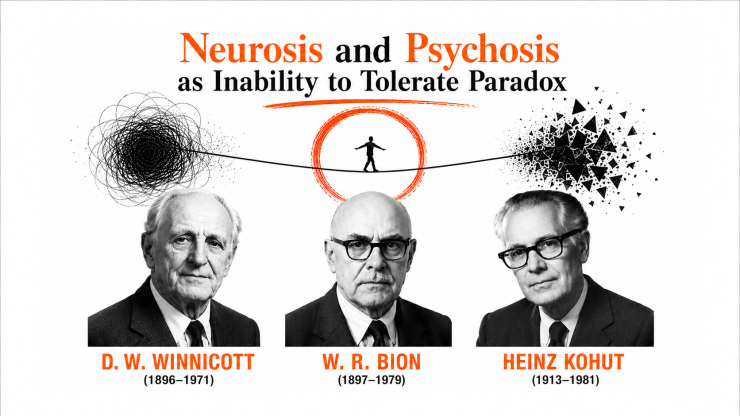
Neurosis and Psychosis as an Inability to Tolerate Paradox
Vladimir Nemet
Toward Metamodern Psychoanalysis
One of the fundamental problems of psychoanalysis is the question of what connects different forms of psychopathology. In other words, is there a common underlying cause of neurosis and psychosis?
Neurosis and psychosis have traditionally been distinguished according to a number of criteria: neurosis is associated with conflict, repression, and the preservation of reality testing, whereas psychosis is associated with a more severe disturbance of psychic organization and a loss of contact with reality. Yet another question can be posed: what if neurosis and psychosis, despite their differences, arise from the same fundamental problem?
According to the Theory of Parallel Identities, this common denominator could be described as the inability to tolerate the paradox and tension between the I and the Thou.
According to this model, personality is not organized around a single central psychic instance. Rather, it is formed through the relationship between two irreducible poles: the Big I and the Big Thou.
The Big I represents the pole of one’s own sovereignty, grandiosity, vitality, and creative power. The Big Thou, on the other hand, represents the radical Other, the Ideal, the Father, and the Law—in other words, everything that transcends the subject and cannot be completely reduced to the subject.
These two poles are not merely opposed to one another. They are mutually dependent. The I can be the I only in relation to the Thou, while the Thou can be experienced as the radical Other only in relation to the I. An irreducible tension therefore emerges between them.
This tension is not pathology. It is a fundamental condition of psychic life.
Pathology emerges when the subject can no longer tolerate the paradox generated by this tension.
From Conflict to Paradox
Classical psychoanalysis largely understood psychopathology through the concept of conflict. In Freud, neurosis arises from the conflict between instinctual demands, the Superego, and the demands of reality. The Ego attempts to regulate this conflict, and when it becomes unbearable, defensive mechanisms are activated. The neurotic symptom represents a compromise formation between opposing psychic forces.
Later psychoanalytic schools shifted the center of the theory. Ego psychology emphasized regulation and adaptation, object relations emphasized the integration of internal objects, while Kohut emphasized the development and cohesion of the self. In doing so, Kohut significantly shifted psychoanalytic theory away from Freud’s conflict model toward the experience of the self, empathy, and selfobject relationships.
Despite these differences, most of these approaches continue to assume that some form of psychic organization must be established or restored.
The Theory of Parallel Identities begins with a different question:
What if a particular psychic tension is not a disturbance that needs to be resolved, but a structure that must be tolerated?
The subject must be able to affirm both the autonomy of the I and the irreducible transcendence of the Thou. The subject must be able to experience his or her own greatness while simultaneously acknowledging that something exists that is greater than the self. The subject must preserve his or her own sovereignty while also accepting the Other.
This is not a conflict that should ultimately be resolved.
It is a paradox.
Donald Winnicott: A Paradox That Does Not Need to Be Resolved
At first glance, Winnicott appears to be the theorist closest to this model. His theory explicitly emphasizes the phenomenon of paradox and the capacity to allow certain opposites to remain unresolved intellectually. His concept of holding is likewise connected with the preservation of continuity of being, while his concept of transitional space allows for the simultaneous experience of the internal and the external.
Yet the difference is significant.
In Winnicott, paradox is associated with development, transitional space, the relationship between the subjective and the objective, and the capacity to allow certain contradictions to remain unresolved rather than forcing them into premature resolution.
In the Theory of Parallel Identities, paradox has a different status.
It is not primarily a developmental paradox that one must learn to tolerate. Rather, paradox arises from the bipolar structure of personality itself.
The I and the Thou are not two developmental stages, nor are they two aspects of some deeper unity. They are two irreducible poles between which personality continually oscillates.
In other words, Winnicott shows why certain paradoxes do not need to be resolved. The Theory of Parallel Identities attempts to show why paradox arises in the first place and how it becomes a structural condition of personality.
Wilfred Bion: Tolerating the Unknown and Emotional Tension
There is also a significant affinity with Bion. His theory of container-contained emphasizes the need for a psychic capacity capable of receiving, processing, and transforming raw emotional experience. Bion likewise approaches the idea of remaining in uncertainty without prematurely closing experience through conceptualization.
Here too, however, there is a crucial difference.
Bion primarily asks whether the psyche can tolerate and metabolize emotional experience that has not yet acquired form.
The Theory of Parallel Identities poses a different question: can the subject tolerate the simultaneous existence of two irreducible poles of his or her own existence?
Bion’s question concerns the capacity for emotional experience. The present model is concerned with the capacity to maintain the Big I– Big Thou relationship.
Thus, “toleration” does not refer merely to the amount of emotional tension a subject can withstand. It refers to the capacity to ensure that neither of the two poles generating the tension is destroyed.
Heinz Kohut: From Conflict to Self
The Theory of Parallel Identities also has a close relationship to Kohut’s psychology of the self.
Kohut made an important shift away from Freud’s conflict model toward the experience of self-cohesion, narcissistic needs, and the relationship to the idealized Other. His clinical approach emphasizes empathy and selfobject relationships as essential to maintaining the integrity and cohesion of the self.
For this reason, Kohut represents an important predecessor to the Theory of Parallel Identities.
However, there is a fundamental difference.
In Kohut, the self remains the central organizing category. Even when fragmented or weakened, its cohesion and development remain therapeutic goals.
The Theory of Parallel Identities takes this one step further.
It does not assume that behind the relationship between the I and the Thou there exists a deeper, integrated self that should ultimately become coherent.
Personality emerges from the relationship between the Big I and the Big Thou itself.
There is no need to discover a third instance that will integrate them. What needs to be developed is the capacity of the subject to remain within their mutual tension.
In this sense, the metamodern model does not replace Freud’s Ego with some new central entity. It questions the need for such a center in the first place.
From Integration to Oscillation
Here lies one of the key differences between this model and most previous psychoanalytic theories. Classical models often attempt to explain how different parts of psychic life can be integrated.
The Theory of Parallel Identities does not assume that complete integration is necessarily the desired state.
The I and the Thou must remain different.
What changes is not their difference, but the subject’s capacity to tolerate that difference.
For this reason, the more appropriate concept is oscillation rather than integration.
Personality is not a fixed structure that, once integrated, no longer requires change. It is a dynamic process in which the perspective of the Big I and the perspective of the Big Thou continually alternate.
The greater the capacity for this movement, the greater the capacity for psychic complexity.
Neurosis: The Reduction of Paradox
From this perspective, neurosis can be understood as an attempt to reduce the tension between the I and the Thou.
The subject may experience the Big Thou as excessively demanding, superior, or threatening. On the other side, the Big I may be equally frightening because of the possibility of shame, object loss, or abandonment.
The psyche therefore lowers, grounds, or deconstructs both poles:
The Big Thou becomes the “ordinary thou”: a partner, parent, boss, or social norm.
The Big I becomes the “ordinary I”: a functional, adapted, rational Ego.
The paradox is thereby softened. Tension is reduced.
But at the same time, the amplitude and vitality of psychic life is reduced.
Neurosis is therefore a reduction of paradox.
Psychosis: The Elimination of Paradox
Psychosis represents a more radical attempt.
When the subject can no longer reduce the tension through neurotic means, one pole may begin to dominate the other:
If the Big Thou completely overwhelms the Big I, the Other may become an absolute authority, a persecutory and paranoid Gaze, or an omnipotent system.
If the Big I overwhelms the Big Thou, the subject may lose the experience of the Other as an autonomous instance and experience the self as the absolute source of value, power, or reality.
In the first case, the Thou absorbs the I.
In the second, the I absorbs the Thou.
In both cases, what disappears is the essential element: the relationship between them. And with it, the paradox.
Psychosis can therefore be understood as the elimination of paradox through the totalization of one pole.
Anger and Grief: The Affective Infrastructure of the I–Thou Relationship
Here we encounter perhaps the most important difference between the Theory of Parallel Identities and its predecessors.
If the I–Thou relationship is the fundamental structure of personality, how can the subject maintain its tension?
The answer is: affectively.
Two fundamental affects are central to this process: anger and grief.
They are not merely emotional reactions to an already existing relationship. Their function is deeper: they enable the maintenance of the distinction between the I and the Thou without requiring the relationship to be severed or either pole to be destroyed.
Anger Protects the Big I
Anger enables the subject to protect his or her own boundary. When the Big Thou becomes too dominant, anger restores the sovereignty of the Big I. It allows the Big I to say:
“I will not disappear into the Other.”
Grief Protects the Big Thou
Grief enables the subject to accept the limits of his or her own power. It allows the subject to say:
“I cannot completely possess you, and yet you remain perfect forever.”
In this way, the Other is recognized as autonomous and irreducible.
Without anger, the Big I may be absorbed into the Big Thou.
Without grief, the Big I may attempt to absorb the Big Thou.
Thus:
anger protects the Big I, while grief protects the Big Thou.
Together, they make possible what is essential:
maintaining difference without breaking the relationship.
The model therefore differs both from the classical understanding of affect as a consequence of conflict and from approaches in which emotional problems are primarily understood as problems of regulation.
Affect here is not merely something to be regulated.
Affect is what allows the I–Thou structure to remain alive.
Why Neurosis and Psychosis Have the Same Root
We can now formulate the common structure of neurosis and psychosis more precisely. Both arise when the subject can no longer maintain the paradox of the I–Thou relationship.
In neurosis, the subject attempts to reduce the tension.
In psychosis, the subject attempts to eliminate the tension by allowing one pole to become absolute.
Neurosis and psychosis are therefore not merely two different categories of pathology. They are two different responses to the same problem:
What does one do when the I–Thou relationship becomes unbearable?
Neurosis responds through flattening.
Psychosis responds through totalization.
Metamodern Mental Health
Metamodern mental health therefore does not mean achieving a final balance between the I and the Thou. Nor does it mean complete integration. And it does not mean eliminating paradox.
It means the capacity to remain in the space between the two poles long enough that neither has to be abolished.
One can be autonomous without being self-sufficient.
One can idealize without becoming submissive.
One can be grandiose without becoming megalomaniacal.
One can feel anger without destroying the Other.
One can feel grief without losing oneself.
In this sense, mental health represents a high capacity for oscillation between the Big I and the Big Thou.
The Metamodern Analyst
A different function of the analyst follows from this.
If the fundamental problem is the inability to tolerate paradox, therapy should not merely reduce conflict or establish some stable equilibrium.
The analyst must provide a space in which the subject can simultaneously experience what previously had to be separated. The subject can be both great and vulnerable, autonomous and dependent, angry and grieving.
In this sense, the analyst functions as an ontological anchor.
The analyst’s function is not to eliminate tension, but to make it possible for tension to be tolerated without the collapse of the I–Thou relationship.
In this respect, this represents a shift from holding and containment toward the maintenance of paradox.
The analyst does not merely hold the patient. Nor does the analyst merely metabolize the patient’s experience. The analyst helps the patient gradually develop the capacity to maintain two mutually opposed yet equally necessary perspectives.
Conclusion: From Resolution to the Capacity to Tolerate
The Theory of Parallel Identities continues some of the most important lines of development in psychoanalysis, but connects them in a different way.
From Freud, it retains the importance of conflict, but replaces conflict with the deeper concept of paradox.
From Winnicott, it takes the idea that certain opposites do not need to be finally resolved, but understands paradox not primarily as a developmental phenomenon, but as a consequence of the bipolar structure of the I–Thou relationship.
From Bion, it takes the importance of the capacity to tolerate emotional tension, but defines this capacity not primarily as the ability to metabolize experience, but as the ability to maintain the relationship between two irreducible poles.
From Kohut, it takes the importance of the Big I and the idealized Other, but rejects the need to posit a central self behind them that would ultimately integrate them.
The metamodern model therefore proposes a shift:
from conflict to paradox,
from integration to oscillation,
from regulation to toleration,
from the central self to the I–Thou relationship,
from affect as consequence to affect as bearer of structure.
At the center of this model are two affects.
Anger protects the Big I; grief protects the Big Thou.
Their simultaneous possibility allows the subject not to choose between the self and the Other.
Neurosis emerges when the subject must reduce the paradox.
Psychosis emerges when the subject must eliminate it.
Mental health emerges when the paradox can be tolerated and maintained.
In this sense, psychological maturity may not be the ability to finally find a balance between the Big I and the Big Thou.
It may be the ability to remain, for long enough, between them.