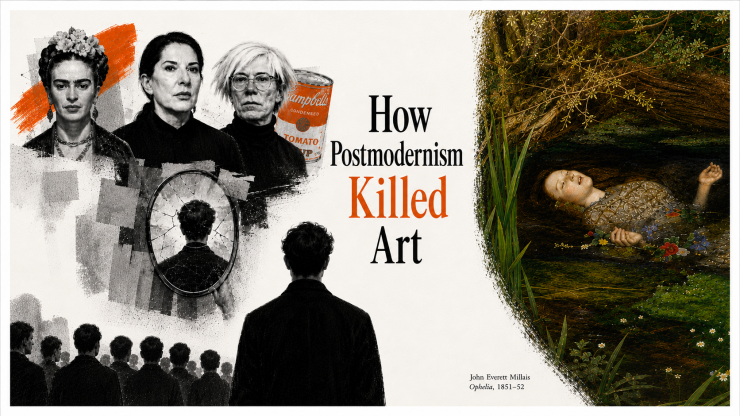
How Postmodernism Killed Art: When Nothing Is Greater Than Me
Vladimir Nemet
The crisis of contemporary art is often described as a crisis of form, institutions, the market, or criteria of aesthetic value. However, a more radical question can be asked: is this not a crisis of the very function of art?
If we look at the history of art from the perspective of its aesthetic and cultural function, we can discern a broad pattern: traditionally, art opened a space toward something that transcended the immediate self. This did not necessarily mean religious transcendence. That “something greater” could be God, but it could also be nature, heroism, love, beauty, truth, tragedy, or the very possibility of human excellence.
In other words, art produced a vertical dimension of experience: it enabled the subject to encounter something that was not determined by its own interests. Something that came before and above it.
Postmodernism represents a radical break with precisely this function.
Its fundamental gesture was to deconstruct the assumption that there is something that is intrinsically higher, better, truer, or more valuable. Beauty came to be understood as a matter of cultural convention, identity as a product of social construction, authority as a historical effect, and ultimately art itself as an institution whose assumptions about value could no longer be taken for granted.
This critique had enormous emancipatory value. It exposed many hidden hierarchies and demonstrated that what presented itself as universal often reflected particular historical and social relations of power.
But this is precisely where the paradox emerges.
What happens to art when there is no longer anything that could be greater than the self?
The Narcissistic Problem
Narcissism is usually described as a phenomenon of grandiosity, a need for admiration, and sensitivity to injury to self-esteem. However, its deeper structure can be formulated differently: the narcissistic self has difficulty tolerating the possibility that there is something whose value does not depend upon it.
The deepest question is therefore not:
“Am I valuable enough?”
but:
“What if there is something more valuable than me?”
That question threatens the self-sufficiency of the self. It opens the possibility of admiration, envy, longing, submission, and a relationship with the Other.
For this reason, the narcissistic defense does not have to take the form of the statement “I am the best.” It can take a more sophisticated form:
“There is nothing that is truly better.”
The first statement still acknowledges a hierarchy of value.
The second abolishes it.
Postmodernism and the Abolition of the Great Thou
I believe we can say that traditional, classical art regularly presupposed the possibility of a Great Thou: something outside the subject that possessed value in its own right and before which the subject could come to a halt.
Postmodern deconstruction systematically calls precisely this possibility into question.
If truth, beauty, morality, identity, and authority are historically produced and constructed, then there is no longer an obvious reason why the subject should acknowledge their superiority.
The critique of absolutes can thus inadvertently produce a new absolutization of the subject.
The self is no longer one among many centers of value. The self becomes the final judge of value.
In this sense, we can speak of a possible narcissistic paradox of postmodernism: a movement that sought to decentralize the subject may have contributed to a culture in which the subject no longer has anything outside itself that could truly transcend it.
In short: A narcissistic society produces narcissistic art.
Narcissistic Art
Narcissistic art should therefore not be defined simply as art that depicts the artist or the artist’s personality, although this is common among many artists. More precisely, it is art in which the self remains the ultimate horizon of meaning and value.
Such a work can be political, conceptual, ironic, or subversive. It can even explicitly speak against narcissism. The question, nevertheless, is whether it still allows for an authentic encounter with something that is not the self.
If every content ultimately returns to the subject, its perspective, its construction, and its interpretation, the work of art begins to function like a mirror.
Instead of:
“Look at something that exists beyond me.”
we get:
“Look at the way I look.”
And then:
“Look at how I construct my own gaze.”
Art thereby shifts from encounter toward self-reflection.
Exhibitionism: When Art Says “Look at Me”
Here another important form of narcissistic art emerges: exhibitionism.
Exhibitionism should not be understood here in its narrow clinical sense, but as a structure of the relationship between the artist, the work, and the audience. Its fundamental message is simple:
“Look at me.”
This is fundamentally different from the traditional artistic gesture:
“Look at what I have created.”
In the first case, the gaze of the Other serves to confirm the self. The artist exposes their body, privacy, intimacy, sexuality, trauma, identity, or personal vulnerability and demands the gaze of the audience. What is exposed is no longer merely a means of artistic expression; the act of exposure itself becomes the artistic event.
In this sense, exhibitionism represents an almost perfect narcissistic structure:
Self → the gaze of the Other → confirmation of the self.
The Other is not needed as Other. The Other is needed as a spectator.
Art no longer creates a space between I and Thou, but uses Thou to increase the visibility of I.
Of course, exposing oneself does not in itself mean that something is not art. The body, autobiography, and personal experience can become authentic material for a work of art. The question is something else: does the exposed self become transformed into something that transcends the artist, or does it remain merely an object of the gaze?
If the work does not lead toward something beyond the artist, but the gaze continually returns to the artist, art begins to resemble public self-presentation.
What matters then is no longer what has been created, but how willing the self is to be seen.
This is the moment at which the boundary between art and exhibitionism begins to disappear.
From Aesthetic Experience to Deconstruction
This also helps explain the similarity between certain forms of postmodern art and the function of psychotherapy.
Deconstruction in psychotherapy can be extremely useful: it exposes false authorities, rigid identities, the harsh superego, internalized prohibitions, and ideologies that present themselves as natural facts.
But there is a difference between therapeutic insight and aesthetic experience.
Therapy may aim to liberate the subject from false absolutes. Art, however, need not and should not end with their destruction. If, after deconstruction, there remains nothing to which the subject can open itself again, then precisely the dimension that gave art its specificity has been lost.
The question after deconstruction is therefore not only:
“What is false?”
but:
“What is valuable after we have exposed what is false?”
Without this second question, deconstruction easily turns into nihilism.
The Metamodern Return of Value
Metamodernism can, in this sense, be understood as an attempt to reestablish the vertical dimension without returning to naïve absolutism.
Metamodern art does not have to claim that it possesses the final truth. It is enough for it to once again allow for the possibility that there is something that cannot be reduced to the subject.
Its fundamental position could be expressed as follows:
“I cannot prove that there is something of absolute value beyond me, but I refuse to live as if there were not.”
This is not a return to modernist certainty. It is an acceptance of the risk of transcendence.
Art can once again open a space toward the Other, without turning the Other into an object that we have finally understood and possessed.
Toward a New Function of Art
If this hypothesis is defensible, then the problem of contemporary art is not simply that it has become too conceptual, subversive, political, or simply “ugly.” The problem is deeper: what if it has lost the capacity to produce the experience that there is something of value beyond the self?
Art that merely confirms the subject can be aesthetically sophisticated, but it remains trapped within a narcissistic structure.
Art that merely deconstructs can be intellectually brilliant, but it leaves the question of meaning open.
On the other hand, art that reestablishes the possibility of the Great Thou does something else: it does not tell the subject that it is worthless, but enables it to discover that it is not the only center of value.
Perhaps this is one of the most important functions of art.
Not to tell us:
“You are great.”
But neither:
“Nothing is great.”
Rather:
“There is something that is not yours.”
Something you cannot possess.
Something you cannot reduce to your own interpretation.
Something whose value does not depend upon your gaze.
Something you can admire.
And perhaps there is even – someone.
In this sense, art is not merely the production of objects, images, texts, or performances. It is a cultural technology of alterity: a way in which society preserves the possibility of experiencing that there is something or someone beyond the boundaries of the narcissistic self.
And perhaps this is precisely the task of metamodern art:
not to restore the old art, but to reopen the possibility that something might transcend us.
Because if there is nothing greater than me, the problem is not merely that art has disappeared.
The Other has disappeared.