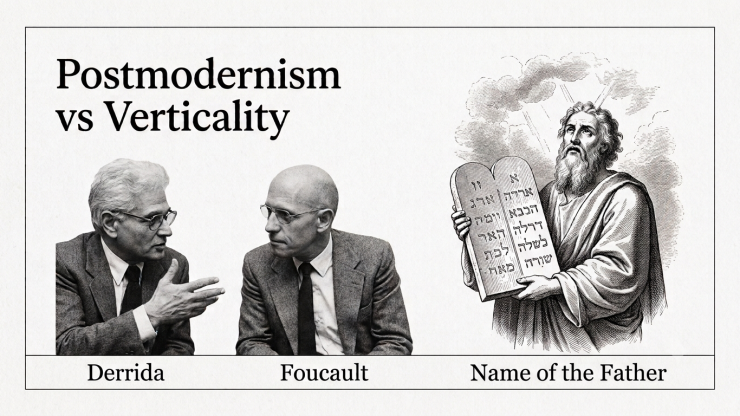
Postmodernism, Antisemitism, and the Crisis of Verticality: From Deconstruction to Metamodernism
Vladimir Nemet
Introduction: The Paradox of Contemporary Antisemitism
In recent years, we have witnessed a remarkable paradox. Within some of the most prestigious Western universities—institutions that have for decades presented themselves as leading defenders of anti-racism, minority protection, and sensitivity toward the Other—forms of rhetoric and action have emerged that no longer represent merely legitimate criticism of the policies of the State of Israel, but sometimes cross the boundary into the demonization of Jews as a people or of Jewish identity itself.
The paradox is not merely political. It is also philosophical.
How is it possible that environments built around tolerance toward difference have become places where hostility toward one of the oldest minority traditions of the West can emerge?
The answer cannot be found only in current political conflicts. These may explain individual events, but they do not explain the cultural pattern that makes certain phenomena especially vulnerable to hostility.
This essay begins from a philosophical and psychoanalytic assumption: certain contemporary forms of antisemitism in the West are connected to a deeper crisis in the relationship toward verticality—to law, authority, continuity, and ideals.
This crisis did not emerge overnight. It is connected to the historical transition from modernity to postmodernism, and today to an attempt at a new synthesis that has come to be called metamodernism.
Modernity: Faith in Universal Verticality
Modernity was an era of strong faith in the possibility of universal foundations.
Reason, science, progress, human rights, and the idea of universal humanity represented an attempt to create a new form of verticality that would no longer depend on tradition or religious authority.
Its great strength was its ability to liberate humanity from arbitrary forms of authority.
However, its weakness was the danger that its own constructions would be mistaken for final truths.
The history of the twentieth century demonstrated that reason, nation, political ideologies, and scientific projects could themselves become new absolutes capable of justifying violence.
From this experience, postmodernism emerged.
Early Postmodernism: The Critique of False Verticals
Early postmodernism emerged as a reaction against the dangers of modern absolutes.
Thinkers such as Derrida, Foucault, and Lyotard did not simply claim that truth does not exist. Their critique was directed toward the ways in which certain truths present themselves as universal while often concealing relations of power.
Their fundamental question was:
Who speaks in the name of the universal, and whom does that universality exclude?
Deconstruction therefore played an important role. It revealed that authority is not always innocent, that institutions can conceal domination, and that the voices of the marginalized must not be ignored.
However, the problem emerges when deconstruction ceases to be a method of critique and becomes the only possible relationship toward reality.
At that point, legitimate authority can no longer be distinguished from abusive authority.
Every vertical structure becomes suspect.
Late Postmodernism: From Critique to the Loss of Verticality
In later forms of postmodern sensibility, a transformation occurs.
Instead of asking:
“Which forms of authority are unjust?”
the question increasingly becomes:
“How can we trust any authority at all?”
Instead of distinguishing truth from ideological manipulation, every claim to truth begins to be interpreted primarily as an expression of power.
Identity is understood almost exclusively as a social construction. Tradition becomes an inheritance of domination. Universal principles become disguised privileges.
The problem is not that postmodernism exposed false forms of verticality.
The problem is that it lost the ability to distinguish false verticality from legitimate verticality.
Human beings can live for a time through criticism, but they cannot live through deconstruction alone.
They need ideals, symbols, values, and orientations that transcend the isolated self.
Judaism as a Symbol of Law and Continuity
Within this context, it becomes possible to understand why Jewish tradition occupies such a significant place in Western symbolic imagination.
Judaism is not merely a religious or ethnic tradition. It represents one of the oldest examples of historical continuity, the culture of the Book, the Covenant, and the Law.
Its fundamental message is that something exists beyond the individual: responsibility, commandment, relation to the Other, and an obligation that precedes personal will.
This is what I mean by verticality.
Verticality does not mean domination. It means that human beings are not closed within their own subjectivity.
For a culture that has lost trust in enduring structures, such a form of identity can become challenging.
Not because it is necessarily hostile, but because it reminds us of something postmodern culture has attempted to leave behind: the possibility that something genuinely transcends the individual.
The Psychoanalytic Dimension: Envy Toward That Which Possesses Structure
Psychoanalysis helps us understand an important dynamic.
When an individual encounters something that possesses value, coherence, or inner structure that they themselves lack, two responses are possible.
The first is admiration.
The object is accepted as something from which one can learn.
The second is envy.
The object must be diminished or destroyed so that it no longer reminds one of one’s own sense of lack.
Nietzsche described this mechanism through the concept of ressentiment.
Psychoanalysis recognizes it as a defense against an unbearable experience of difference.
Of course, it is impossible to reduce every critic of Israel or every postmodern thinker to such a dynamic.
However, as a cultural pattern, it may help explain why phenomena representing continuity, law, and identity are often placed under particular pressure from processes of deconstruction.
The Paradox of Victimhood
One important characteristic of contemporary political discourse is the division of the world into oppressors and victims. Such a division can serve a legitimate function when it draws attention to real injustices. However, the problem arises when it becomes the only moral criterion. Individuals and communities are then judged not primarily by their actions, but by their position within a predetermined structure of power.
This framework reflects one of the lasting influences of postmodernism. By challenging universal moral standards and emphasizing the analysis of power relations, postmodern thought encouraged a view in which political identity increasingly derives from one’s location within systems of domination rather than from shared ethical principles. While this perspective has exposed many genuine forms of oppression, it has also made the distinction between victim and oppressor the primary lens through which social reality is interpreted.
Historically persecuted Jews easily fit into the category of the victim. But when they appear as a political subject with their own institutions, state, and capacity for self-defense, a tension emerges. Within a worldview that privileges victimhood as the primary source of moral legitimacy, Jewish sovereignty becomes difficult to accommodate. The same people who once embodied vulnerability are now perceived through the language of power.
If a community is acceptable only as long as it remains weak, then victimhood itself becomes an identity that must never be overcome. At that point, legitimate political criticism can cross the boundary and become hostility toward identity itself. What begins as a critique of power risks becoming a refusal to accept that victims may also become autonomous historical subjects without thereby losing their moral dignity.
Metamodernism: The Return of Verticality After Deconstruction
The way out of this crisis is not a return to old absolutes.
Modernity revealed the dangers of overly confident universal systems.
Postmodernism revealed the dangers of false authority.
But humanity cannot permanently remain in a state of endless suspicion.
This is where metamodernism emerges.
Metamodernism does not reject postmodern critique, but refuses to remain within its emptiness.
It attempts to restore ideals while remaining aware of their limitations.
This is a new form of verticality: not absolute, but reflexive.
A verticality that knows it can be mistaken, yet still believes that without ideals there is no humanity.
In this sense, metamodernism attempts to unite two necessary truths:
Postmodernism taught us that every authority must be questioned.
Metamodernism reminds us that without some form of authority, meaning, and ideals, human beings lose orientation.
Conclusion: Antisemitism as a Symptom of a Crisis of Meaning
It is impossible to explain every form of contemporary antisemitism through a single theory.
But we can ask a deeper question:
What happens to a culture that no longer believes in any legitimate form of verticality?
When every boundary becomes suspect, every identity a construction, and every authority a hidden form of domination, society loses the ability to distinguish protection from weakness, power from violence, and tradition from oppression.
Antisemitism emerging within parts of contemporary academic culture can therefore be understood as one symptom of a broader cultural crisis.
A crisis of a civilization that has learned how to dismantle old foundations but has not yet learned how to build again.
This is precisely the challenge of metamodernism: to discover a new verticality after deconstruction—not one that closes itself against the Other, but one that allows the Other to be encountered again as a face, a value, and a call.