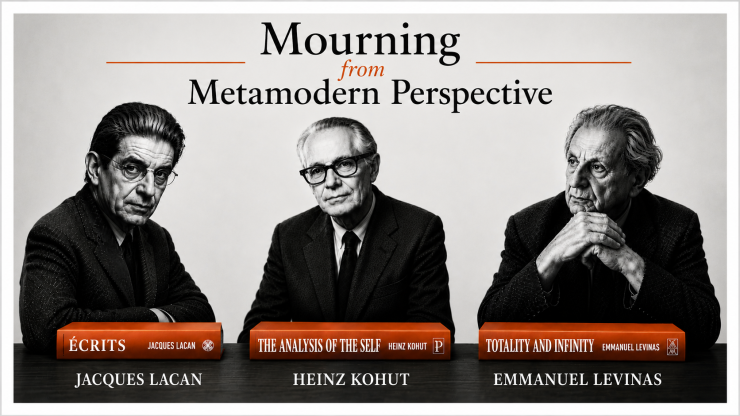
Mourning from a Metamodern Perspective
Vladimir Nemet
Mourning: Renunciation of the Ideal or Its Preservation?
One of the most enduring assumptions of psychoanalysis is that mourning is a process in which the subject gradually becomes disillusioned with the idealized object. What was loved, idealized, and psychically invested must be repositioned within the boundaries of reality. The ideal must be brought down to the level of the real.
From Freud onward, mourning has therefore generally been understood as a working-through of loss. The subject must accept that the object is no longer available, that it is not what the subject imagined it to be, and that the so-called libidinal investment must be withdrawn from it. In various theoretical forms, the same idea appears later as well: psychological development entails the capacity to tolerate the limited, imperfect, and separate Other.
Within this framework, the phenomenon of idealization is necessarily something that needs to be corrected. What we saw as perfect reveals itself to be imperfect; what we experienced as exceptional reveals itself to be ordinary; what was above us must be brought back down to the level of reality.
However, this text begins from a different possibility:
Perhaps mourning is not a way of renouncing the ideal, but the only way of keeping the ideal alive. Perhaps mourning is the only way to apprehend the eternal perfection of the Other.
I do not mean by this that the loved person is perfect. People have flaws, make mistakes, disappoint us, and can be profoundly imperfect. The issue lies elsewhere. What if what we call the ideal was more than our fantasy of a person?
What if, within idealization, behind all our projections, there nevertheless lay an intimation of something real—the experience that the Other is more than we can comprehend?
Mourning, then, would not be the bringing down of the Other from the height of the ideal into reality. It would be precisely the opposite: the realization that the Other has always, from the very beginning, been whole, without flaw, beyond the possibility of any deconstruction.
The attempt to bring Otherness down to the level of the real, its deconstruction, is therefore nothing other than an attempt to avoid the feeling—often deeply painful—of profound mourning.
Lacan and Kohut: Two Ways of Working with Idealization
The client does not come to psychoanalysis with a symptom alone. The client also comes with a certain expectation of the Other: the analyst may be attributed knowledge, understanding, strength, or the capacity to see what the client cannot see. In this sense, the therapeutic relationship may be marked by idealization from the very beginning, that is, by the experience that there is someone before the subject who is, in some sense, above them and possesses what they themselves lack.
Lacan and Kohut understand this phenomenon from seemingly different theoretical perspectives;
For Lacan, the analyst occupies the position of the “subject supposed to know” (sujet supposé savoir). At the beginning of the analysis, the patient attributes to the analyst knowledge of their own personality, longing, and desire. Yet the very task of analysis is gradually to call this presupposition into question. The analyst does not confirm their position as the one who knows; rather, through their practice, they destabilize it. What initially appears as the transcendence of the Other is thus gradually returned to the field of the signifier, lack, and the subject’s own desire.
With Kohut, the path is more than similar. At the beginning of analysis, the analyst may be experienced as an idealized selfobject who provides strength, security, and cohesion. Like Lacan’s analyst, the analyst here is also an object presumed to know. Through the methods of so-called optimal frustration and transmuting internalization, however, the functions that the patient initially found in the Other are gradually incorporated into the patient’s Self. What initially came from outside becomes an inner capacity.
As we know, there are many differences in their theories and approaches. But with regard to Otherness, the therapeutic goal of Lacan and Kohut is almost the same. Lacan may deconstruct the idealized position of the Other, whereas Kohut gradually internalizes it; Lacan may show that the Other is not the ultimate guarantor of knowledge, while Kohut may enable what the Other provided to become part of the internal structure of the Self. In both cases, however, the transcendence of the Other ultimately loses its original force. What initially appeared as something that transcended the subject or came to the subject from outside eventually returns to the subject—either as a revealed illusion or as an internalized function.
This is understandable from the perspective of psychoanalysis, one of whose fundamental tasks is to distinguish psychic construction from reality. Yet it is precisely here that a question emerges which requires a different philosophical perspective: what if the experience that the Other is greater than us is not merely a projection? What if, within idealization, despite all its phantasmatic elements, there nevertheless lies an intimation of something real?
Mourning as the Recognition of the Perfection of the Other
The phenomenological perspective allows us to pose this question differently. In our lives, the Other does not appear merely as an object to which the subject subsequently attributes certain qualities, but as someone who, from the very beginning, eludes complete comprehension. Their Otherness is not something that could be eliminated through better understanding; rather, the impossibility of fully comprehending them is itself part of the experience of encountering them.
Here Emmanuel Levinas becomes particularly important. The Other is not simply what I have not yet come to know well enough, but what ultimately resists being reduced to my world and my categories.
The “height” of the Other does not mean that they are a perfect person or a morally superior being, but that something appears in the encounter with them that transcends me.
If we accept this, then we must also understand idealization differently. It may be filled with our projections and fantasies, but it does not follow from this that the very intimation of the Other’s uniqueness is illusory. We may create a perfect image of the Other while nevertheless intuitively sensing something true: that they are more than anything we can know about them.
This is precisely why mourning need not mean bringing the Other down from the height of the ideal into the boundaries of reality. Their singularity then becomes clearer: no one else is this person, and no one else can take their place.
In this sense, mourning is not the realization that perfection does not exist, but the realization that we cannot be part of another’s perfection. This may be a more painful, but also deeper, claim. We do not mourn because it turned out that the Other was merely an ordinary, limited person whom we mistakenly idealized. Quite the opposite: we discover that the Other was whole from the very beginning and has remained so, without flaw, yet we cannot fully participate in this perfection.
Perfection here does not mean the absence of flaws. The Other may be weak, fallible, selfish, or may hurt us. Their imperfection as a person does not call into question the perfection of their Otherness. For Otherness is not a quality that the Other could possess to a greater or lesser degree; it signifies the fact that they are irreducibly who they are and can never be exhausted by our experience of them.
Otherness signifies absolute perfection.
The Eternal Other
It is precisely for this reason that something paradoxical can occur through mourning. While the Other was present, their presence enabled an experience of closeness in which the difference between us could, at moments, almost disappear. We could feel that we were part of the same world, the same experience, and even that there was something between us that transcended our individual separateness. Loss interrupts this possibility. But what remains is not merely absence. What remains is a clearer awareness that the Other was never merely what they were for us.
What is then revealed is what we might call the eternal Other. The eternal here does not mean that the person continues to exist outside of time, but that their singularity can no longer be erased. Someone was once precisely this Other; that encounter happened precisely as it did, and it can never be repeated with someone else. What was unrepeatable remains unrepeatable.
Here, from a metamodern perspective, lies an important distinction between idealization and the ideal. The postmodern perspective can rightly show that our images of the Other are constructions, projections, and interpretations. But it does not necessarily follow that what the ideal was attempting to express is itself merely a construction. We can reject the perfect image while preserving the experience that the Other was and remains more than any image we may have of them.
Mourning therefore need not be a process through which we learn that the Other was not ideal. It can be a process through which our ideal is freed from what we ourselves have put into it. When projections, expectations, and fantasies of unity recede, what remains need not be an ordinary, “realistic” object.
What may remain is precisely what was hidden beneath the image: the Other in their irreducibility.
Conclusion
Perhaps this is also where we find an answer to the question of why all true loves are sad. Sadness does not necessarily arise from the failure of love, nor from the fact that the ideal was false. It arises from the very structure of love for the Other: we can approach them, we can love them, and we can share our lives with them, but we can never cross over into their Otherness. We cannot be the Other.
Therefore, mourning is not simply the renunciation of the ideal. It is the moment in which it becomes visible that the Other has always been more than our representation of them. Our image may fall apart, but what made that image possible need not disappear.
Perhaps it is precisely then that the ideal, for the first time, ceases to be a fantasy of a perfect person and becomes something deeper: the experience that the Other is perfect precisely in their Otherness.
We do not mourn because perfection does not exist.
We mourn because we cannot belong to it.
And because the Other is eternal, our mourning can never end.