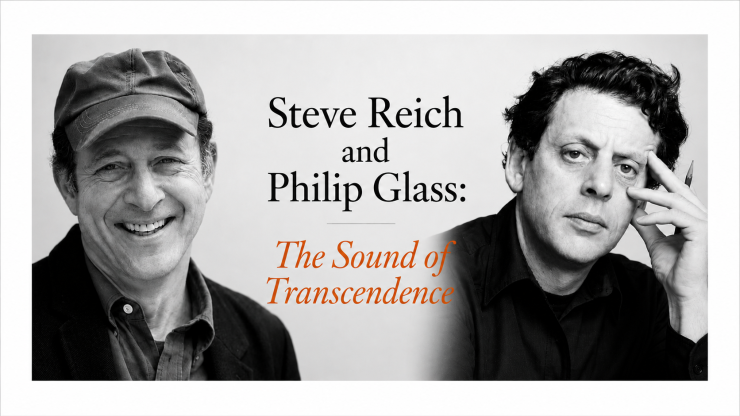
Steve Reich and Philip Glass: The Sound of Transcendence
Vladimir Nemet
On the Secular Sacred in Music
Every now and then, not very often, something happens in a concert hall that is difficult to explain. Listening to music, one suddenly feels that something is approaching—something that is not oneself. It is not simply beauty, emotion, or pleasure. It is an encounter with something other—with something that transcends us.
Music then becomes a passage from everyday life into a world that exists above us and before us. A space of transcendence opens up.
From the beginning of human history, we have tried to open a path to the other side. Religions created spaces, rituals, symbols, and texts for this purpose. Art, however, has sometimes managed to do something unexpected: to allow us to experience the transcendent where we were not looking for it.
This raises a paradoxical question: how is it possible that an encounter with the holy sometimes takes place in an ordinary concert hall, while it may fail to occur precisely where the holy is officially present—in a church or a temple?
Perhaps the answer lies in the distinction between the sacred and the holy.
The sacred is that which has already been designated as holy: a particular space, ritual, text, symbol, or time. The holy is something else. It is not so much determined by a place or a rule as by the experience of radical Otherness—the experience of encountering something that is not our I, something that comes from beyond us and transcends our own horizon.
What Is Radical Otherness?
We may be deeply moved by music, painting, or words, and yet everything may still take place within our own world, within a horizon that is already familiar to us. We may be shaken, excited, or delighted without the Other ever truly appearing.
Within what we call the sacred, we may follow a liturgy or ritual, recite sacred words, and participate in a holy ceremony while remaining enclosed within our own experience. We may be in a sacred space without the holy actually occurring.
With the holy, something else happens. It is not merely that something happens within us; rather, we encounter something that is not us. Something comes from beyond us and refuses to be completely appropriated. We cannot fully explain it, control it, or turn it into a part of ourselves. We may approach it, try to understand it, and give it a name, but it always retains something that eludes us.
That is radical Otherness.
The Sacred and the Holy
This is precisely why it is important to distinguish the sacred from the holy.
Within the sacred, Otherness is predetermined and normative. Religion tells us where the holy is, what is holy, and how we are to approach it. God, the altar, the sacred book, the ritual, and the temple already have their designated place. When we enter such a space, we already know—or at least believe we know—what we are encountering.
This can be a profound religious experience. Yet there is a paradox here: the more completely Otherness is predetermined, the less room there is for its actual discovery.
The sacred tells us: this is the Other.
The holy, by contrast, says: something Other might appear here.
In the first case, Otherness has already been named. In the second, it may surprise us.
This is why the sacred and the holy are not the same. The sacred can even become an obstacle to the holy when we mistake the sign for what the sign is meant to open up. Once we already know what is holy, we may stop waiting for the holy to truly encounter us.
And this is precisely why something unusual can sometimes happen: a concert hall can become a space of the holy.
There are no sacred walls here, no rituals, no dogma. No one tells us that we are about to encounter something that transcends us. There is no predetermined Other.
And precisely for this reason, the concert hall can become a freer space for transcendence.
Here, the holy is not given.
Here, it can only be discovered.
This is why the contemporary American composers Steve Reich and Philip Glass are so interesting to us.
Steve Reich: Otherness That Appears
In Steve Reich, radical Otherness is not found in some predetermined religious content. His music does not speak of God, depict the holy, or lead us into an already designated space of transcendence. Quite the opposite: Reich begins with extremely simple, almost stripped-down musical material.
And it is precisely from this simplicity that something unexpected begins to appear.
Reich’s music is built upon repetition, phase shifting, and gradual change. The listener spends a long time listening to what is already familiar. Yet at some point, one begins to hear something that neither the composer nor the listener has consciously produced. Between the tones, rhythms, and their repetitions, new patterns, new accents, and new sonic figures begin to emerge.
This may be the most important aspect of Reich’s music.
The Other is not outside the music. It appears within it.
The listener does not encounter something that has been presented in advance as the Other. Instead, the listener hears something familiar and repetitive, and then, suddenly, something unexpected emerges from within the familiar. It is as though the music itself begins, at a certain moment, to produce more than what was deliberately placed within it.
And something even more important happens: neither the composer nor the listener knows exactly what is happening.
The composer can precisely determine the structure, duration, rhythms, and relationships between the instruments. He can know how the work has been constructed. But he cannot fully predict everything that will emerge from that structure in the actual experience of listening. Nor can the audience know in advance what it will hear. One may know the piece, one may listen to it ten or twenty times, and yet each time it may open itself in a different way.
This is not merely a consequence of the listener’s subjective mood. Something within the music itself appears anew each time.
Each new listening can reveal something that the previous listening did not reveal.
This is one of the essential properties of radical Otherness: the Other can never be completely exhausted by what we already know about it. If it could be known once and for all, named, and reduced to the familiar, it would no longer be radically Other.
In Reich, then, Otherness does not appear as some hidden content that we must eventually discover. It appears as the inexhaustibility of the encounter. The music remains the same, but the encounter with it is never entirely the same.
We can recognize its emergence, but we cannot fully determine what we are going to hear. We can approach it, but we cannot exhaust it.
There is something profoundly different here from the sacred.
In sacred music, Otherness is most often already determined: we know that we are addressing God; we know the meaning of the ritual, the text, and the symbols.
In Reich, there is no predetermined Other. There is no sacred content that we are expected to recognize.
Otherness simply happens.
This is why Reich’s music can be secular and yet open a space for the holy. It does not tell us that something is holy. It creates the conditions in which the holy can appear.
Perhaps this is precisely why repetition is so important in his music. Repetition initially encloses us within the familiar, but gradually frees us from the need to constantly search for something new. When we stop expecting an event, we begin to hear what happens between events.
Then the familiar begins to change.
And what was the same is no longer the same.
In that small interval between what we expect and what actually appears, a space for Otherness opens:
Something gradually transforms into Someone.
Reich therefore does not offer transcendence as a message. He produces it as a possibility of experience.
His music does not say, “This is the Other.”
It brings us to the moment when we can feel, “This is not me—You are.”
Philip Glass: Otherness Through the Great Other
In Philip Glass, the vertical dimension emerges in a different way.
Whereas Reich approaches Otherness through time, repetition, and the unpredictable relationships that emerge from them, Glass often constructs it through great human figures and great themes. His operas bring back into contemporary art what modernity and postmodernity had long called into question: great individuals, great stories, metanarratives, truth, history, and transcendence.
His works Einstein on the Beach, Satyagraha, and Akhnaten do not speak merely about Einstein, Gandhi, and Akhenaten. These historical figures become figures of Otherness—figures of the Great Other who emerge before us and invite us to step beyond the confines of everyday life.
But here too, Otherness is not predetermined.
Glass does not tell us who Einstein is, what truth is, what nonviolence means, or who God is. He does not give us a final answer. Instead, he brings us into a space of questions.
In Satyagraha, Gandhi becomes a figure of truth and nonviolence. But what we encounter is not merely the historical Gandhi. What opens before us is a question about truth, its power, and the possibility of relating to it through one’s own life.
In Akhnaten, we are confronted with the question of God and the absolute. Yet neither God nor the absolute is simply present as a ready-made fact. They appear as a question that reaches into us.
In Einstein on the Beach, we encounter the possibility of an almost secular holiness of knowledge, time, and the cosmos. Einstein is not merely a scientist from the past. He becomes a figure before whom something opens that exceeds our ordinary measure of the world.
Here Glass approaches the same experience of Otherness that we found in Reich, but by another path:
With Reich, the Other appears through the form of the music
With Glass, the Other appears through the content of the music.
Yet in both cases something essential remains: the Other cannot be fully understood or possessed.
With Reich, we cannot completely predict what will emerge from the musical structure. With Glass, we cannot exhaust what appears to us through a historical figure. The more we know about that figure, the more new questions may open before us.
Glass therefore does not say: this is holy.
He creates a situation in which we can ask:
What is it that we are encountering here?
This is why Glass’s works, too, can open themselves differently each time we encounter them. Not because their meaning is arbitrary, but because what we encounter is never fully exhausted by our previous understanding.
In Glass, then, the vertical dimension is an encounter with the Great Other.
We do not encounter something that has already been explained to us.
We encounter a figure that opens before us the question of something greater than ourselves.
We do not know it completely.
We can only approach it gradually.
And it is precisely in the space between what is familiar and what still eludes us that the possibility of the holy appears.
The Holy as an Event
This is where Reich and Glass ultimately meet.
Neither offers the holy as a ready-made fact. Their music does not begin by asserting that what follows is holy. The concert hall is not a temple. Precisely for this reason, it can become a place of encounter.
The traditional sacred space says:
Here is the holy.
The secular concert hall says:
Nothing here is holy in advance.
And it is precisely in this second situation that something surprising becomes possible.
For if the holy truly means an encounter with radical Otherness, then it cannot be completely predetermined. We cannot command it to come. We cannot produce it through ritual. We cannot guarantee it through an institution.
We can only leave room for it to encounter us.
Here the possibility of the metamodern holy opens up.
Metamodernism does not return to premodern religion, but neither does it accept the postmodern claim that every form of transcendence is merely a construction. After everything modernity has done to religion, and postmodernity to grand narratives, the possibility still remains that a human being can be struck by something that is not oneself.
We are not returning to the old holy.
We are reopening the possibility that the holy might happen.
This is why the concert hall may today be a better place for transcendence than a sacred space.
Not because the secular is better than the religious.
But because the open is better than the predetermined.
In a sacred space, one may seek confirmation of a holiness that has already been shown to us.
In a secular space, one may be surprised by a holiness one did not expect.
And surprise may be the first sign of a genuine encounter with Otherness.
Conclusion
This is why Reich and Glass can be understood as bearers of a new vertical dimension.
Reich builds it out of time; Glass out of great themes and great figures. Yet both open the same space: a space in which our I can encounter something that is not itself.
Perhaps this is why, from time to time, something happens in a concert hall that fails to happen in a church or temple. Not because the concert hall has become a new temple, but because Otherness is not predetermined there.
The sacred tells us where the holy is.
The holy allows us to discover it.
And in the metamodern experience, this encounter no longer requires either the dissolution of the Great I or the rejection of the Great Thou.
The Great I remains standing before the Great Thou.
It does not submit to it, but opens itself to it.
And it is precisely in this space between I and Thou, between autonomy and transcendence, that the vertical dimension may reappear.
Not as a return to the old religion, but as the possibility of a new encounter.
Perhaps this is where the metamodern holy begins.