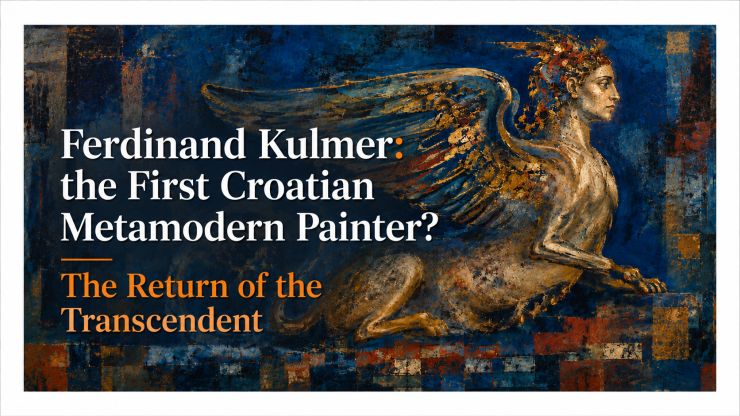
Ferdinand Kulmer and the Psychology of Metamodernism
Vladimir Nemet
From the Autonomous I to the Great Thou
Ferdinand Kulmer occupies an unusual place in Croatian painting of the second half of the twentieth century. Croatian art history rightly describes him as one of the major protagonists of Croatian abstraction and late modernism, but also as a painter who was among the first to re-enter figuration and who, in the 1980s, became associated with postmodernist stylization and with mythological and heraldic motifs.
His oeuvre is characterized by remarkable variability and hybridity: from Fauvist figuration and Picasso, through Art Informel, Tachisme, monochromy, gestural painting, and calligraphy, all the way to the new figuration. (Croatian Encyclopedia)
But it is precisely this unusual variability that allows for another reading of Kulmer:
Kulmer can be viewed as a pictorial representation of the psychological transition from modernism through postmodernism toward what we can today call – a metamodern sensibility.
Not in the sense that Kulmer was historically a metamodernist. The concept of metamodernism emerged long after his artistic activity. Rather, his work, viewed from today’s perspective, allows us to see in art a psychological structure that is important for metamodern psychology: the relationship between the I and the Thou, or between the Great I and the Great Thou.
In this sense, Kulmer is not merely a painter of different styles. His oeuvre can be understood as a – psychogram of the modern subject.
Modernism: The Liberation of the I
Modernism is, among other things, a great history of the liberation of the subject.
The painter no longer has to represent the external world according to the prescriptions of tradition. He does not have to remain faithful to the object, the academic canon, religious iconography, or conventional beauty.
The painting can become an autonomous fact.
This is the moment when the “artistic I” says:
I can create my own world.
Kulmer’s abstract period is precisely part of this great modernist liberation. Beginning in 1957, he entered abstraction and subsequently passed through Tachisme, Art Informel, Abstract Expressionism, gestural painting, and calligraphy. His painting never ceased to explore the possibilities of the act of painting itself.
In psychological terms, modernism can therefore be understood as the – emancipation of the Great I.
The I no longer has to derive its meaning from the Great Thou.
There does not have to be a God, tradition, myth, history, or predetermined order telling it what it should be.
This is an enormous achievement of modernism.
But at the same time, a problem emerges.
If the I is completely autonomous — what can still transcend it?
And here we encounter what we might call – the narcissistic form of modernity.
Postmodernism: When the I Itself Begins to Dissolve
Postmodernism radicalizes the modernist suspicion.
If modernism said:
“I do not need tradition in order to create.”
postmodernism asks:
“But where does my I come from in the first place?”
The author is no longer completely sovereign. Identity reveals itself as a construction. Style becomes quotation. History can be reused, but without necessarily believing in its former truth.
Grand narratives become suspect.
And this is precisely where a psychological problem emerges that is important for metamodernism.
If everything is a construction, then the Great Thou can also be deconstructed.
God, tradition, heroism, beauty, holiness, history, love, authority — all can be viewed as cultural constructs.
The I is not merely liberated from the Great Thou.
The Great Thou loses its right to be great.
And here we encounter what we might call – the depressive form of postmodernity.
The problem is that – nothing is any longer sufficiently great to move us.
Kulmer’s Unusual Return
This is precisely why Kulmer’s later work is so fascinating.
After decades of abstract experimentation, the entire mythological cycles begin to appear: Lady with the Unicorn, The Judgment of Paris, Three Masks of Zeus, Ganymede’s Capers, The Tenderness of the Griffin, The Pathetic Triptych, and Pegasus. The Croatian Encyclopedia describes his later development as a synthesis of abstraction and figuration, spontaneous gesture and coded arabesque, followed by a return to figuration with mythological and heraldic content.
At first glance, this appears to be a postmodern return to history. But psychologically, something much more interesting may be happening.
Kulmer does not bring back myth because he was unfamiliar with modernism.
He brings back myth precisely because he knew modernism.
That is a tremendous difference.
He can no longer believe in myth in the same way as a nineteenth-century painter. Yet at the same time, he no longer wants to reduce it merely to quotation.
Here we encounter something that would later become characteristic of the metamodern sensibility:
I can know that something is problematic and nevertheless – allow it to touch me again!
Kulmer and the Pre-Raphaelite Moment
This is why something resembling the Pre-Raphaelite relationship to art can be sensed in some of Kulmer’s late works. (John Everett Millais, Dante Gabriel Rossetti, Edward Burne-Jones, John William Waterhouse.)
Not so much stylistically as in the psychological relationship to the ideal.
The Pre-Raphaelites reintroduced myth, legend, beauty, symbol, and an idealized world into art. But their fundamental gesture was affirmative: they did not merely want to play with the past; they wanted to restore its value.
Kulmer does this after modernism.
His return is therefore not a restoration.
It is a return after – the loss of innocence.
Thymos: The Capacity for Something to Become Great Again
Here the concept of thymos becomes important.
Thymos is often too quickly interpreted as the need for recognition, making it appear to belong exclusively to the Great I. But there is another, deeper possibility.
A person can be moved not only by the need to be great, but also by the capacity to recognize – something great outside oneself.
In this sense, thymos is the capacity to stand before greatness. Admiration, pride, honor, heroism, devotion, enthusiasm — these can all be understood as different forms of one fundamental affect:
something is great enough to move me.
Here thymos approaches the Great Thou.
Thus metamodern thymos is not simply:
“I am great.”
It says:
“I can be great because – I can stand before something great.”
Metamodernism Is Not Synthesis
Here an important distinction must be made from the classical concept of synthesis. Metamodernism does not necessarily mean that modernism and postmodernism are finally reconciled into some higher unity. That would once again be an attempt to find a single center.
The metamodern structure may be different:
modernism and postmodernism remain present simultaneously.
Neither cancels the other.
I can know that myth is constructed and still experience it as meaningful.
I can know that beauty has no objective proof and still allow myself to be overwhelmed by it.
I can be autonomous and still acknowledge the authority of something outside myself.
I can be critical and still believe.
This is a psychological structure that can be called the – optimal paradox.
Kulmer and the Great Thou
From this perspective, Kulmer’s mythological motifs need not be interesting merely because they represent particular mythological figures.
What matters more is what happens to the subject who looks at them.
Pegasus is not important merely because it is Pegasus.
What matters is that, within the space of the painting, the possibility of something greater than the everyday I appears once again.
The same applies to the griffin, Zeus, Ganymede, the unicorn, or the heraldic figures. They create the possibility of a world in which the subject is not the final instance of meaning.
That is the Great Thou.
Not necessarily understood religiously.
Not necessarily as a literal deity.
But as the structural possibility that – something exists outside me that is not merely my projection.
Why Is This Not Simply Postmodernism?
Interestingly, the Croatian Encyclopedia explicitly places Kulmer’s return to figuration within the postmodernist stylization of the period. The Croatian Biographical Lexicon likewise speaks of his mythological and heraldic cycles as connected to contemporary postmodernist stylization, including myth and allegory.
Historically, this is justified.
But this is precisely where my interpretation begins.
The same artistic gesture can be historically postmodern and psychologically anticipate a metamodern structure.
The question is not merely:
“Is this a quotation from the past?”
but:
“How does the subject relate to what it quotes?”
If myth is merely an ironic quotation, we are dealing with postmodernism.
If myth is once again permitted to function as a source of meaning, even though the subject knows that it can no longer possess a naive belief in it, then a metamodern potential emerges.
From the Great I Toward the Great Thou — Without Losing the I
Here art and psychotherapy meet.
Modernist psychology might say:
Become who you are!
Postmodern psychology asks:
And who is this “I” that says “I”?
Metamodern psychology adds:
You can be I and simultaneously acknowledge that there is a Thou who is not you.
This is not a regression toward authority. Nor is it the negation of autonomy.
It is relationship.
The Great I is not opposed to the Great Thou. It becomes possible precisely through its relationship with it.
And thymos is the affective energy of that relationship.
Conclusion: Kulmer Does Not Go Back
Kulmer can therefore be understood as one of the interesting Croatian precursors of a metamodern sensibility, not because he anticipated the term “metamodernism,” but because his oeuvre reveals a problem that metamodernism would later formulate:
How can we reopen a space for greatness after learning to doubt all great values?
Kulmer’s answer is not theoretical. It is pictorial.
After abstraction, he brings back the figure.
After modernism, he brings back myth.
After autonomy, he reopens the possibility of the Other.
After deconstruction, he once again allows the symbol to act. But he does not simply return to tradition. He has already passed through modernism.
That is why his Pegasus is no longer the same Pegasus that existed before modernism.
It is Pegasus after abstraction.
And this is precisely what makes him interesting for metamodern psychology. Because the metamodern I is not an I that has returned to premodern faith.
It is an I that says:
I know that I cannot prove that something is Great.
I know that my experience is always limited.
I know that I may be mistaken.
And nevertheless – I can stand upright before something greater than myself.
And that is precisely why his oeuvre may be one of the most interesting Croatian illustrations of what we today call – metamodern psychology.